 logo
logo



A Salesforce survey reveals that 81% of the sales reps say buyers research the brand on their own before choosing to connect with a sales team. This stat is closely related to how demand and lead generation behave in an age when digital media has a phenomenal influence on B2B marketing.
Have you been wondering what the difference between the two is? In this article, we shall map out the differences, the overlapping areas and how B2B companies can utilize both to drive more sales.
By the end of this article on demand generation vs lead generation, you will know:
- What is lead generation?
- What is demand generation?
- The difference between the two.
- Goals of lead generation.
- Goals of demand generation.
Demand Generation vs. Lead Generation
(Please note: The TalentBridge example is fictional and is used solely to explain the theoretical concepts of demand generation and lead generation in marketing.)
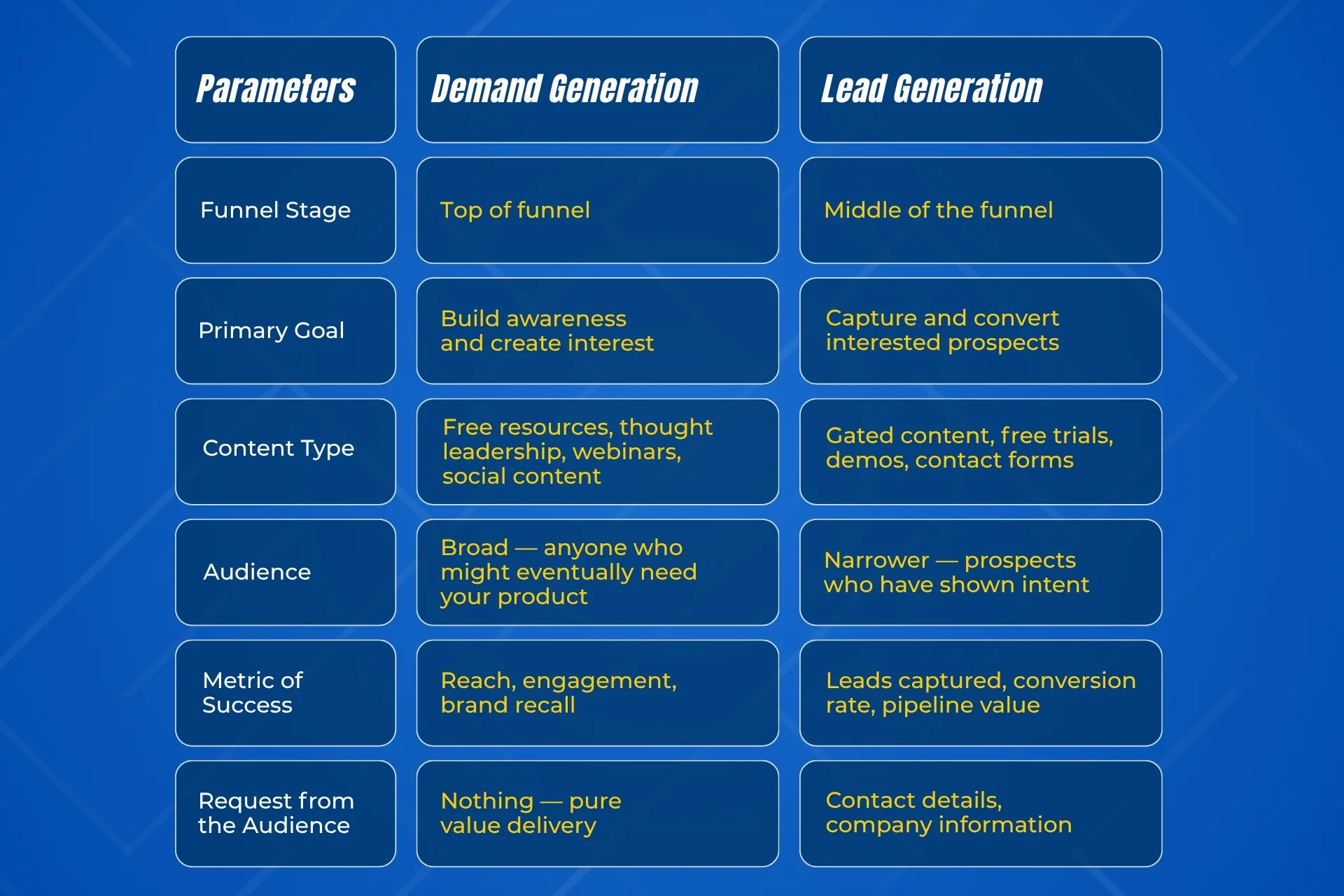
Demand gen strategy is active at the top of the funnel. The word ‘demand’ in itself is suggestive here. Demand generation helps create interest in a B2B product or a service. On the other hand, lead generation takes place at the middle and bottom of the B2B marketing funnel, identifying credible prospects and pulling them into an ecosystem to initiate the sales conversation.
A better way to understand the difference is through an example:
TalentBridge — a SaaS company that sells an AI-powered HR automation platform to mid-size enterprises.
Demand Generation in action: TalentBridge publishes a research report titled “The Hidden Cost of Manual HR Processes in 2024”.
The company makes it freely available to anyone on its website — no form, no gate. They boost it on LinkedIn, run a webinar on HR automation trends, and their CEO writes thought leadership pieces on why traditional HRMS tools are failing modern teams.
At this stage, TalentBridge isn’t asking for anything. They are building awareness and shaping the conversation so that HR Directors start to recognize this problem and consider better ways to solve it.
Lead gen meaning and lead generation in action: A few weeks later, some of those same HR Directors come back. Now TalentBridge offers a “Free HR Efficiency Audit” — but this time, it’s behind a form that asks prospects for their name, company size, and current tools.
Those who fill it out are entered into the CRM, scored based on company size and budget signals, and handed to the sales team for a discovery call.
The demand generation phase didn’t try to sell anything. Rather, it created the need. The lead generation phase stepped in once that need was felt, capturing intent and converting interest into a pipeline.
In other words, demand generation made HR Directors aware that their pain was solvable. Lead generation identified which of those HR Directors were ready to act on it.
The table below sums up the demand generation vs lead generation discussion so far:
Demand Generation vs. Lead Generation – A Comparison
What are the Goals of Demand Generation?
According to Salesforce, demand generation is primarily about creating interest in your brand, product, or service. It can also reignite interest in an existing offering that has seen a dip in sales or bring lapsed customers back into the fold.
While building awareness is the most common goal, there are several other aims:
1. Expanding your audience
A well-executed demand generation campaign can introduce your brand to net-new prospects while also re-engaging existing customers who may not be aware of newer offerings.
2. Building brand authority
Demand generation positions your brand as an industry leader by spotlighting the innovation and differentiators that set you apart from competitors.
3. Driving lead generation
Done right, demand generation feeds directly into your lead generation pipeline — getting prospects excited enough about your offering to take the next step.
4. Educating and nurturing
Demand-generation content gives prospects the knowledge they need to recognize your product or service as the right solution to their problem.
What are the Goals of Lead Generation?
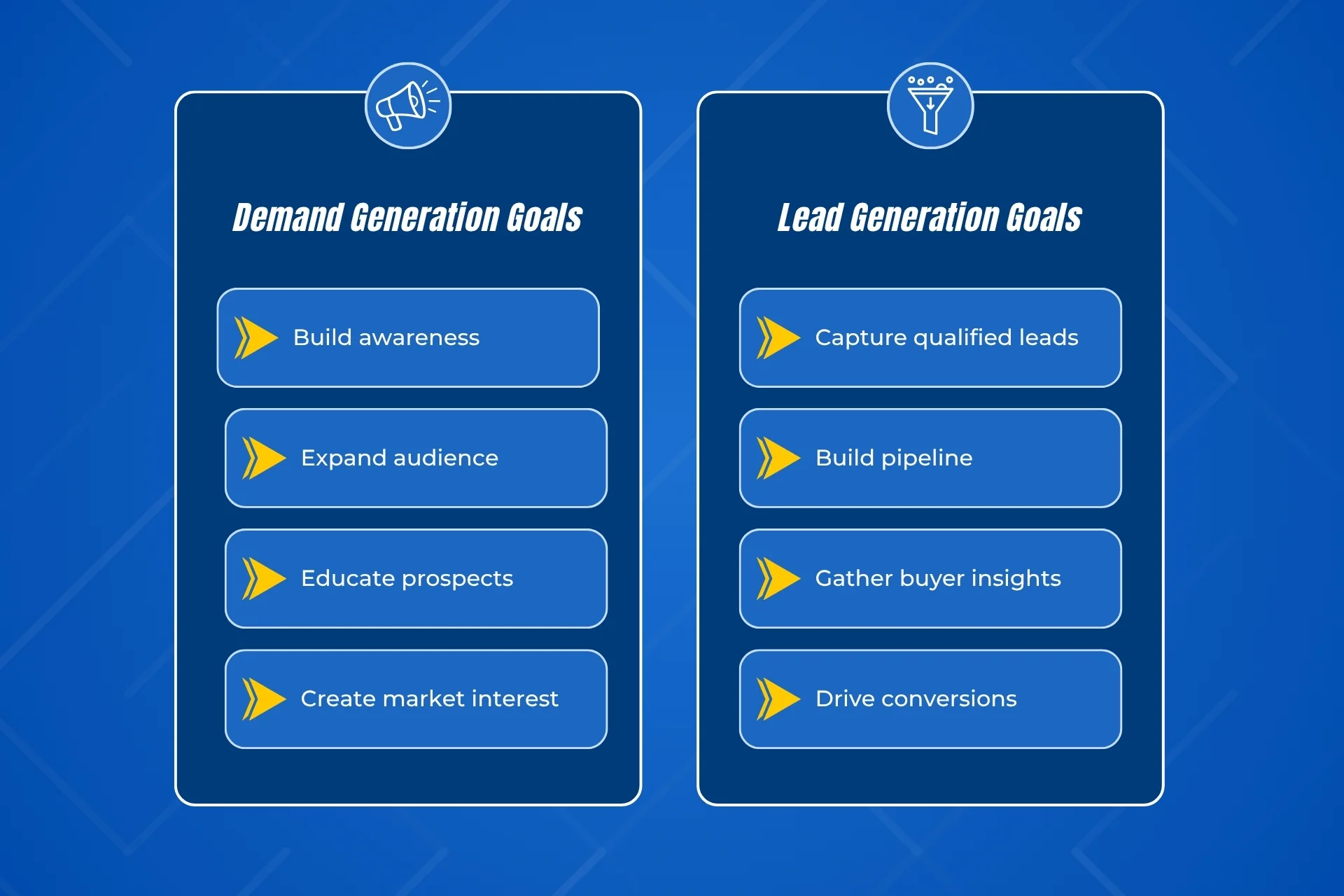
Lead generation is the stage where the focus shifts from awareness to conversion — closing sales and growing revenue. For the sales team, this means entering the buyer’s journey early, building trust, and nurturing that relationship until the prospect is ready to commit.
Beyond closing deals, these are the key goals:
1. Building your lead database
Every sales organization needs a consistent flow of new leads to sustain growth and scale effectively.
2. Improving trust and loyalty
Lead generation isn’t just about volume. Leads need to be properly qualified, so sales teams can build meaningful, solution-centred relationships with the right people.
3. Gathering customer insights
Observing how leads behave through the qualification process gives sales teams a clearer picture of their needs, preferences, and pain points — enabling more personalised outreach.
4. Engaging quality leads
When a prospect downloads a whitepaper or signs up for a webinar, that’s a signal worth acting on. Following up with these leads opens the door to deeper conversations and higher conversion potential.
How Demand and Lead Generation Work Together
Marketing does not work in isolation. Theoretically, the definitions may differ, and the functions could be divided. However, in practice, the two must work in unison to build brand image, attain trust and drive sales.
A closer look at the section below will explain it better:
Buyers do not make a purchase simply because a company is asking them to. What buyers and B2B decision makers are aware of is the problem their own companies face – from production lines to the HR department.
Demand generation strategies begin when decision-makers are not even aware that a product exists. The demand generation campaign will help capture their interest and nurture it through the B2B marketing funnel.
Hence, practically, it is not demand generation vs lead generation. Rather, it is demand and lead generation.
When Should Companies Use Demand Generation Strategies?
Here are some common business situations where demand generation can make a real impact:
1. Connecting with the audience
In the B2B sphere, the product or service owners must inform the target audience that there is a solution to their problem. At this point, organic marketing strategies like SEO optimized blogs and LinkedIn may prove worthwhile. However, these must be coupled with targeted emails and paid ads. The main focus here is a compelling message that highlights the pain points and offers the correct solution.
2. The need to build credibility
Once the brand is known, building credibility is important. Making a brand well-known is not the same as building credibility. Here is a quick example:
Demandbase strengthened its buyer trust in 2024–2025 by earning ISO 27001:2022 certification and renewing its SOC 2 Type II compliance.
Rather than relying only on brand visibility or product messaging, the company used third-party security certifications to prove its reliability and data protection standards to enterprise customers.
This matters because Gartner reported 69% of B2B buyers still turn to sales representatives to validate information before making a purchase decision. The example shows that while awareness may attract attention, credibility is built when independent proof points — such as certifications, customer validation, and industry recognition — reduce perceived risk and reassure buyers that the company can be trusted.
Research from SurveyMonkey and Reddit’s 2026 “The Hidden B2B Journey” report found that 73% of B2B decision-makers trust peer recommendations more than vendor-created content, highlighting why testimonials, certifications, and independent validation are critical for building credibility.
3. Using education as a tool
HubSpot built brand credibility not through advertising, but through education. Its free certification programmes — covering inbound marketing, content strategy, and CRM — positioned the company as an industry authority long before prospects were ready to buy. By the time a decision-maker evaluated a CRM purchase, HubSpot was already the trusted name in their professional development. That is demand generation working at the credibility layer.
HubSpot also has a Demand Generation Playbook that marketers can read.
4. Showing up on the right channels
If the outreach is not generating expected results, the problem may be the messaging. However, it could also be the medium used. For B2B mid-sized companies, the most recommended channels for outreach are LinkedIn, paid ads, websites, networking events and email marketing. A better way to analyse this is to see how the existing customers were acquired and double down on that process.
5. Launching something new
Whether you are entering a new market, launching a B2B product, or introducing a new service line, the priority is creating market confidence before driving conversions. Focus on reaching the right decision-makers through channels they already trust, like:
- Industry events
- Analyst coverage
- LinkedIn thought leadership
- Customer communities
- And strategic partnerships
Prioritize business outcomes rather than product features by showing how the solution reduces risk, improves efficiency, or drives measurable ROI.
At this stage, the goal is to build credibility, educate buyers, and generate interest long before procurement conversations begin.
When Should a Company Use B2B Lead Generation Tactics?
Once you have built brand awareness and generated genuine market interest, the next step is identifying and qualifying the prospects most likely to buy. Lead generation is how you turn that interest into a structured pipeline. Here are three effective tactics to get started:
1. Build lead generation assets
Demand generation efforts have already put the brand on the radar of potential buyers. Now the strategy is to give them a reason to raise their hand.
Develop high-value content and make it available across the channels your target accounts actively use. These could be:
- Industry reports
- ROI calculators
- Solution briefs
- Benchmark studies
When a prospect downloads an asset, that is your cue to follow up. Use that touchpoint to open a conversation, understand their business challenges, and demonstrate how your solution addresses them.
2. Cross-promotion and strategic partnerships
Partnering with a complementary brand is one of the most efficient ways to expand the reach into new accounts. Co-branded webinars, joint whitepapers, or bundled offerings can introduce the solution to a pre-qualified audience that already trusts your partner.
3. Referral programmes and brand advocates
A company’s most satisfied customers are also the most credible voices. Structured referral programmes or formal advocacy initiatives can generate warm, high-intent leads that are significantly easier to convert than cold outreach.
In B2B, a peer recommendation often carries more weight than any campaign.
The Right Balance Between Demand Generation and Lead Generation
Demand generation and lead generation accomplish different goals, but help you boost brand awareness and generate sales. They work together to inform and pique the interest of potential buyers to move them through your sales funnel.
While you can use lead generation strategies on their own, it’s typically better to run a demand generation campaign at the same time; this creates the demand that results in outreach. Create buzz for your offer, attract qualified leads, and nurture them into satisfied, long-term customers.
Key Takeaways
- Demand generation and lead generation are sequential, not interchangeable – Demand generation creates the conditions for lead generation to work. Running lead generation without demand generation is like opening a store no one knows exists.
- The funnel stage determines the strategy – Demand generation belongs at the top of the funnel — building awareness and shaping buyer perception before intent forms. Lead generation belongs in the middle and bottom, where that intent is captured and converted into the pipeline.
- Content type and audience expectation differ significantly between the two – Demand generation delivers value without asking for anything in return. Lead generation introduces a value exchange — gated content, demos, or trials — in return for contact information and qualification signals.
- Over-indexing on lead generation without demand generation is a costly mistake – Teams that skip the awareness phase typically face lower-quality leads, longer sales cycles, and higher cost-per-acquisition — because prospects arrive cold, without prior trust or familiarity with the brand.
- The most effective B2B growth strategies integrate both – Demand generation continuously fills the top of the funnel with educated, aware prospects. Lead generation converts that awareness into a measurable pipeline. Together, they form a complete revenue-producing system — not two separate campaigns running in parallel.
FAQs
Demand Generation vs Lead Generation
1. What is the main difference between demand generation and lead generation?
Demand generation and lead generation operate at different stages of the buyer journey and serve different purposes. Demand generation works at the top of the funnel as it:
- Builds awareness
- Shapes perception
- And creates market interest before a buyer is actively evaluating solutions
Lead generation picks up from there, identifying which of those aware prospects have developed enough intent to enter a sales conversation.
2. Why is demand generation important in B2B marketing?
In B2B, purchase decisions are rarely impulsive. Decision-makers research independently, consult peers, and form opinions about vendors long before they speak to a sales rep.
Demand generation ensures the brand is part of that early research phase, so that by the time a prospect is ready to evaluate solutions, the company is already on their shortlist.
Without it, even a well-resourced lead generation programme ends up competing for attention at a stage where buyers have often already made up their minds.
3. Can lead generation work without demand generation?
Technically, yes. However, the results tend to be limited.
Without prior demand generation, lead generation targets a cold audience that has no existing awareness of or trust in your brand. This typically produces:
- Lower conversion rates
- Longer sales cycles
- And higher cost-per-acquisition
This happens because the sales team is doing the work of building credibility from scratch on every call. Demand generation reduces that friction before the lead generation process even begins.
4. Which strategy should businesses prioritize?
The honest answer is that it depends on where the business currently sits. Early-stage companies or those entering a new market should weigh demand generation more heavily because the priority is building awareness and earning trust before pushing for conversions.
Companies with an established brand presence and a warm addressable market can afford to invest more aggressively in lead generation.
Most mature B2B organizations run both in parallel, with demand generation continuously feeding the top of the funnel while lead generation works to convert what's already there.