 logo
logo



Most B2B marketing teams are not losing deals because their product is wrong. They are losing them because they are showing up too late. By the time a prospect fills out a form, requests a demo, or engages with an outbound sequence, they have already done the research. In many cases, they have already shortlisted vendors.
Forrester’s 2024 Buyers’ Journey Survey found that B2B buying today is largely a process of confirmation, not selection. Buyers already know who they want to work with before they even begin gathering requirements.
The window where positioning, messaging, and outreach actually influence outcomes is not at the bottom of the funnel. It is at the top, before the formal buying process begins. And that is precisely where intent data benefits operate.
This article breaks down:
- What intent data is.
- How it changes conversion outcomes at each stage of the funnel.
- And what real deployment looks like in practice.
The Problem With Waiting for the “Form Fill”
The traditional B2B lead generation model runs on a familiar rhythm.
This is how it goes:
- Launch a campaign
- Wait for form submissions
- Qualify leads manually
- Follow up
It is a model built around response, not prediction. The problem is that the buyer’s journey has fundamentally shifted.
Gartner’s 2024 research shows that B2B buyers now spend only 17% of their total buying time in direct contact with potential vendors. The remaining of the journey is self-directed.
That means by the time a rep connects with a prospect, the evaluation is well underway. The shortlist has likely already been drafted. The team that gets in front of a buyer first has a structural advantage over every team that waits for inbound signals.
This is the gap that intent data is built to close.
What Is Intent Data
Intent data is a category of behavioral signals that indicate when a company or individual is actively researching a problem your product solves. It is not demographic data. It is not a contact list.
It is evidence of in-market activity that suggests a buying cycle may be underway inside an account.
At its core, intent data benefits answers a question that firmographic data cannot – which of the target accounts are actively researching right now?
There are several different types of intent data.
Read about it here.
What Intent Data Does to Conversion
The case for intent data is not theoretical. A growing body of research documents its impact across the funnel reflecting the conversion rate optimization B2B firms.
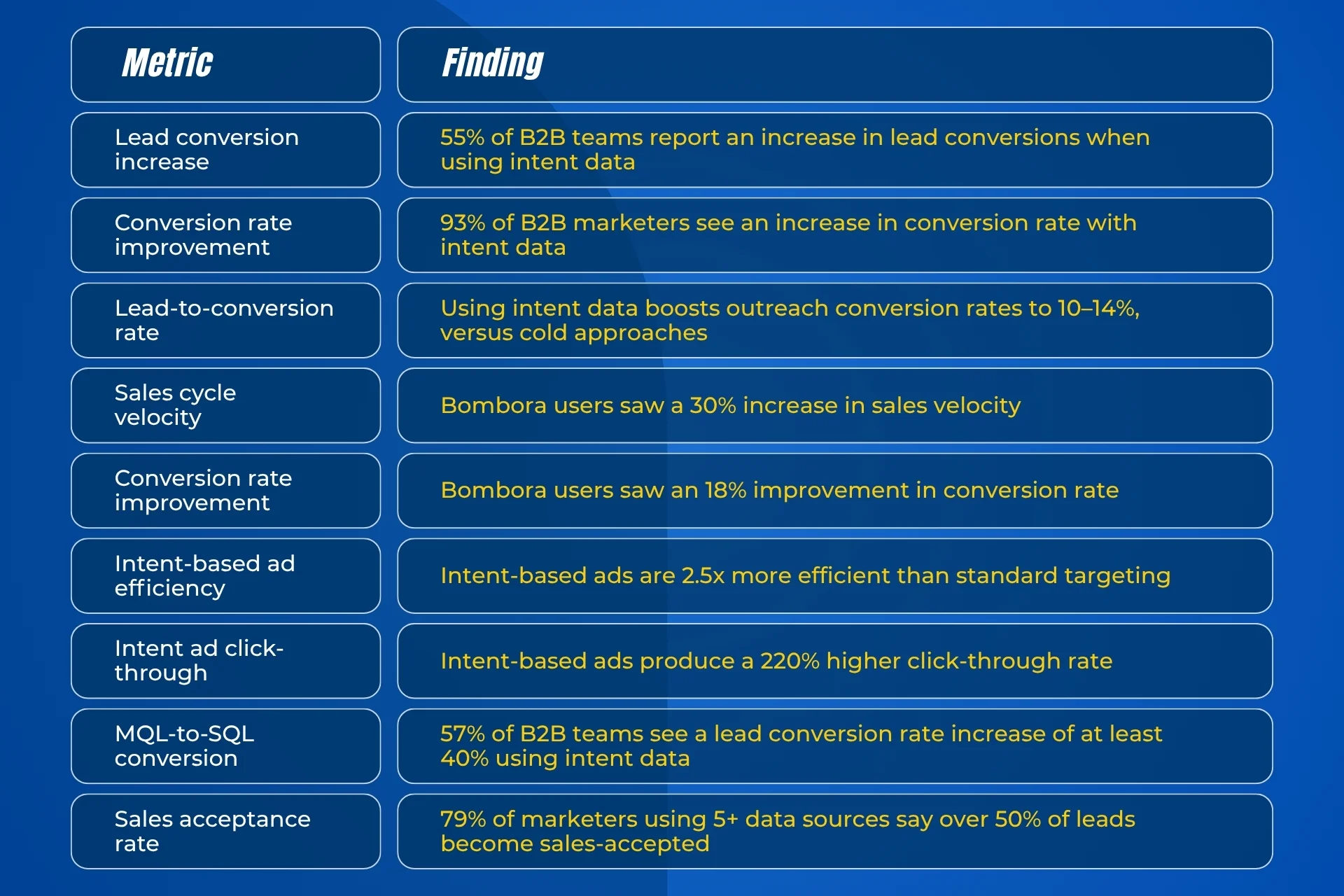
The Forrester Consulting commissioned study on Bombora — arguably the most rigorous third-party evaluation of intent data ROI to date — found that the composite organization experienced $5.4 million in quantified benefits, 342% ROI, faster sales velocity, improved conversion rates, and a 10% reduction in customer churn. The study also noted 4,500 hours saved per year in data management efficiencies.
One Bombora customer, Metadata’s VP of Marketing Jason Widup, reported $7.2M in influenced pipeline and 193% ROI from using intent-powered signals to identify accounts in research mode as a part of data-driven marketing strategy.
How to Build an Intent-Driven Conversion System
The biggest implementation mistake B2B teams make is treating intent data as a single tool. Its strength lies in its integration as a sequenced system, connected across the full funnel.
Step 1: Map Your Signal Layer
Before selecting a platform to reap intent data benefits, define which behavioral and firmographic signals have historically correlated with conversion in your pipeline. Common indicators include:
- Job title and seniority level of the engaged contact
- Company size and industry segment
- Pages visited on your website (particularly pricing, case studies, and product detail pages)
- Content downloaded, especially late-stage assets like comparison guides or ROI calculators
- Email engagement patterns and recency
- Third-party keyword surge activity on topics related to your category
This step is foundational. Without a clear signal map, scoring models are built on assumptions rather than historical conversion data.
Step 2: Choose the Right Intelligence Layer
Match your signal map to the platform best suited to your go-to-market motion.
For inbound-dominant teams, a CRM-native scoring tool like HubSpot AI or a conversational AI platform is the right starting point. These tools surface intent signals inside the tools your team already uses, and can trigger personalized nurture sequences automatically.
For outbound or account-based teams: a third-party intent platform like Bombora or 6sense is better suited, providing early-stage signals on accounts that have not yet engaged with your brand.
Demandbase and Foundry are strong options for teams running ABM programs at scale.
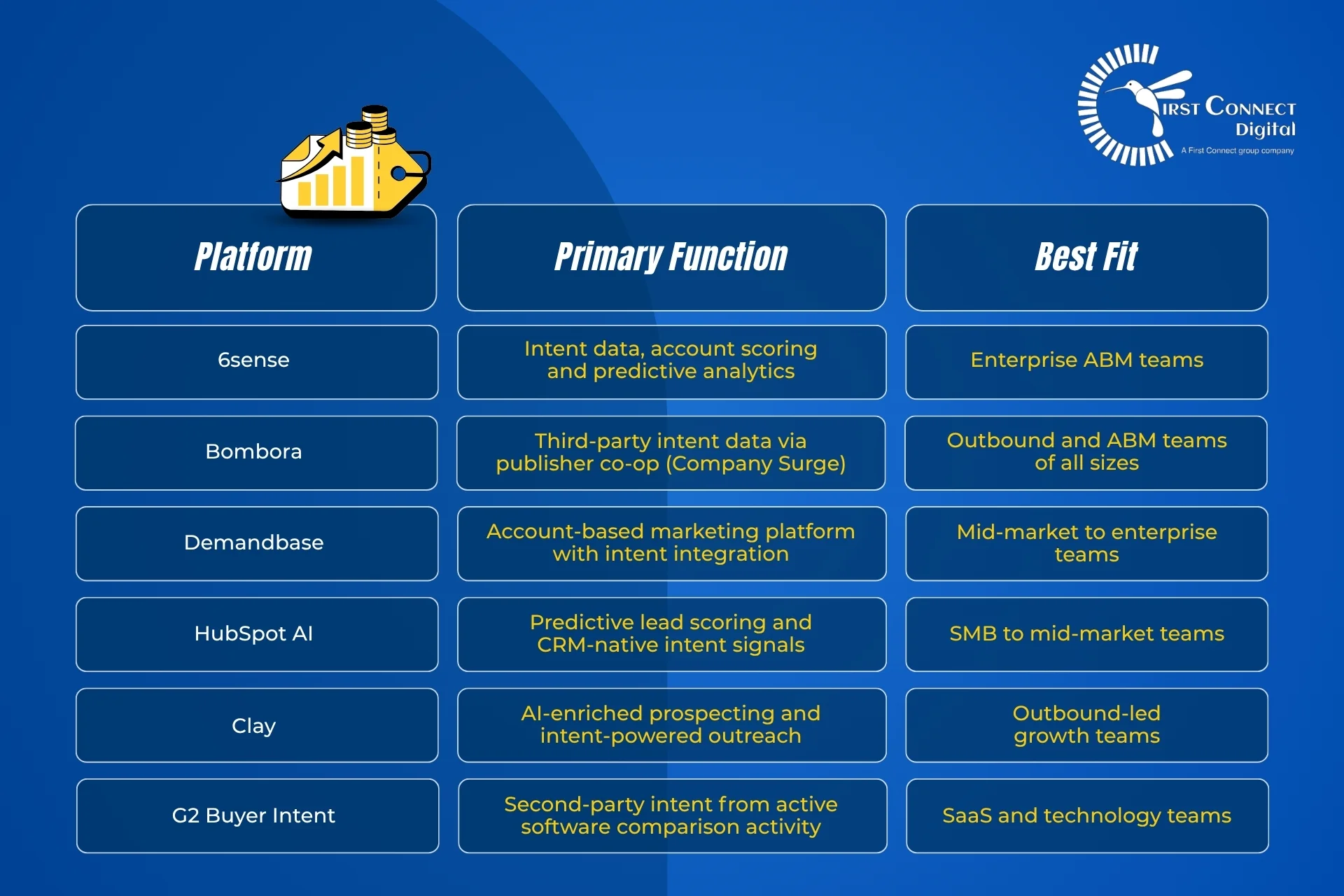
Many mature B2B teams combine two or three of these platforms, each handling a distinct stage of the funnel.
Step 3: Integrate Into the Sales Workflow
Intent data that lives outside the rep’s daily workflow will not drive adoption. The scoring output, intent alerts, and recommended next actions must surface inside the tools the team already uses. This is not a nice-to-have — it is the single most important factor in whether an intent data investment produces results.
The best implementations embed signals at the account record level in Salesforce or HubSpot, trigger workflow automations based on defined thresholds, and surface recommended actions — book a call, send a case study, initiate an ad sequence — without requiring manual interpretation.
Step 4: Measure Intent-to-Pipeline Velocity
Traditional lead generation is measured by volume like MQLs, form fills, and open rates. Intent data benefits offer a different measurement framework.
Track the following metrics from deployment:
- Intent-signal-to-opportunity time: how quickly does a flagged account move to an active opportunity?
- Pipeline coverage from intent-sourced accounts versus non-intent accounts
- Conversion rate of AI-scored or intent-scored leads versus non-scored leads
- Meeting-to-opportunity conversion rate across intent-qualified versus standard outreach
B2B organizations that align sales and marketing teams around shared data and signals achieve 24% faster revenue growth and 27% faster profit growth over three years, according to Forrester (2023). Shared intent data is one of the clearest mechanisms for driving that alignment.
Conclusion
The conversation around intent data is often framed in terms of efficiency like fewer wasted calls, better-targeted ads, lower cost per meeting. Those outcomes are real.
But the more significant shift is strategic as intent data moves B2B teams from a volume model to a timing model.
In a volume model, the assumption is that enough outreach will eventually surface the right accounts. In a timing model, the question is which accounts are actually in-market right now, and how to reach them before the window closes.
Approximately 5% of the total addressable market is actively buying at any given time. Intent data is how high-performing teams identify and engage that 5% before competitors do. (Prospeo, 2026)
The global intent data market is projected to exceed $4.5 billion by 2026, growing at approximately 16% annually. Adoption is no longer limited to enterprise teams with large budgets. CRM-native tools and modular ABM platforms have brought intent data within reach for mid-market and SMB teams, making it a viable strategy regardless of team size.
The adoption numbers reflect the shift:
- 67% of B2B respondents now use intent data for digital advertising, and 57% use it for lead generation, according to Intentsify’s State of Intent Data 2024 report. The competitive question is no longer whether to invest in intent data — it is how to operationalize it.
Key Takeaways
➜ Most of the buyer journey is invisible to traditional outreach. Gartner’s 2024 data shows 80% of the B2B buying journey is self-directed. Intent data surfaces this dark funnel activity before prospects raise their hand.
➜ Earlier engagement is a structural advantage. Forrester research confirms that many buyers have already formed preferences before the formal buying process begins. Intent data allows teams to enter the conversation while it is still being shaped.
➜ The impact on conversion is documented. 55% of B2B teams report increased lead conversions with intent data; 93% of marketers see conversion rate improvements; Bombora users recorded 18% higher conversion rates and 30% faster sales velocity in a Forrester TEI study.
➜ 91% of teams use intent data, but only 24% see exceptional ROI. The gap is activation — signals that live outside the rep’s workflow consistently underperform. Integration into Salesforce, HubSpot, or existing sales engagement tools is non-negotiable.
➜ The right entry point depends on funnel stage. Inbound-dominant teams should start with CRM-native scoring. Outbound and ABM teams should layer in third-party platforms like Bombora or 6sense. Combining first- and third-party data produces the strongest signal.
Frequently Asked Questions
How Intent Data Improves Conversion Rates by 3X in B2B Marketing
1. What is the difference between intent data and lead scoring?
Lead scoring assigns a value to a lead based on demographic or behavioral attributes — job title, company size, pages visited. Intent data is a signal layer that informs scoring. Traditional lead scoring works with data you already have.
Intent data introduces signals from outside your owned channels, giving teams visibility into in-market activity that would otherwise be invisible. The most effective lead scoring models combine both.
2. How long does it take to see results from intent data?
Most intent platforms require a calibration period of four to eight weeks before scoring recommendations become reliably accurate.
Teams using conversational AI or CRM-triggered workflows based on first-party intent can see pipeline impact within two to four weeks. However, 61% of B2B teams report it takes six months or longer to see a full return, primarily because activation workflows take time to build and optimize.
3. Is intent data suitable for SMBs, or only enterprise teams?
Intent data is now accessible across all market segments. CRM-native tools like HubSpot AI and Clay are specifically designed for smaller teams with limited technical resources.
Enterprise platforms like 6sense and Demandbase are built for large revenue organizations running complex ABM programs. The right entry point depends on current pipeline volume and where conversion loss is greatest in your funnel.
4. What is the biggest mistake teams make with intent data?
Treating it as a list rather than a signal layer. Intent data is not a replacement for prospecting infrastructure. It is a prioritization and timing tool. Teams that route raw intent signals directly to sales without filtering, enrichment, and context tend to see high false-positive rates and low adoption.
The highest-performing implementations embed intent outputs directly into the tools reps already use, with clear thresholds and recommended actions attached to each alert.