 logo
logo



There is a version of digital marketing where marketers could find out nearly everything about a buyer without them ever knowing. Their browsing habits, their purchases on other sites, their inferred interests, all of it assembled by data brokers and sold to the highest bidder.
For years, this was just how things worked. That version of marketing is ending.
Privacy legislation like GDPR and CCPA has fundamentally changed how customer data can be collected, stored, and activated. Browser-level privacy restrictions have eroded traditional tracking mechanisms. And buyers themselves, especially in B2B, have become far more aware of, and resistant to, opaque data practices.
According to a Deloitte report, 73% of consumers are more willing to share their data with brands that are transparent about how it will be used.
Trust, in other words, is now a prerequisite for data collection, unlike before when it was only an afterthought. In this article on first-party vs third-party data, we shall explore the two and find out what B2B marketers should do here.
What Is First-Party and Third-Party Data
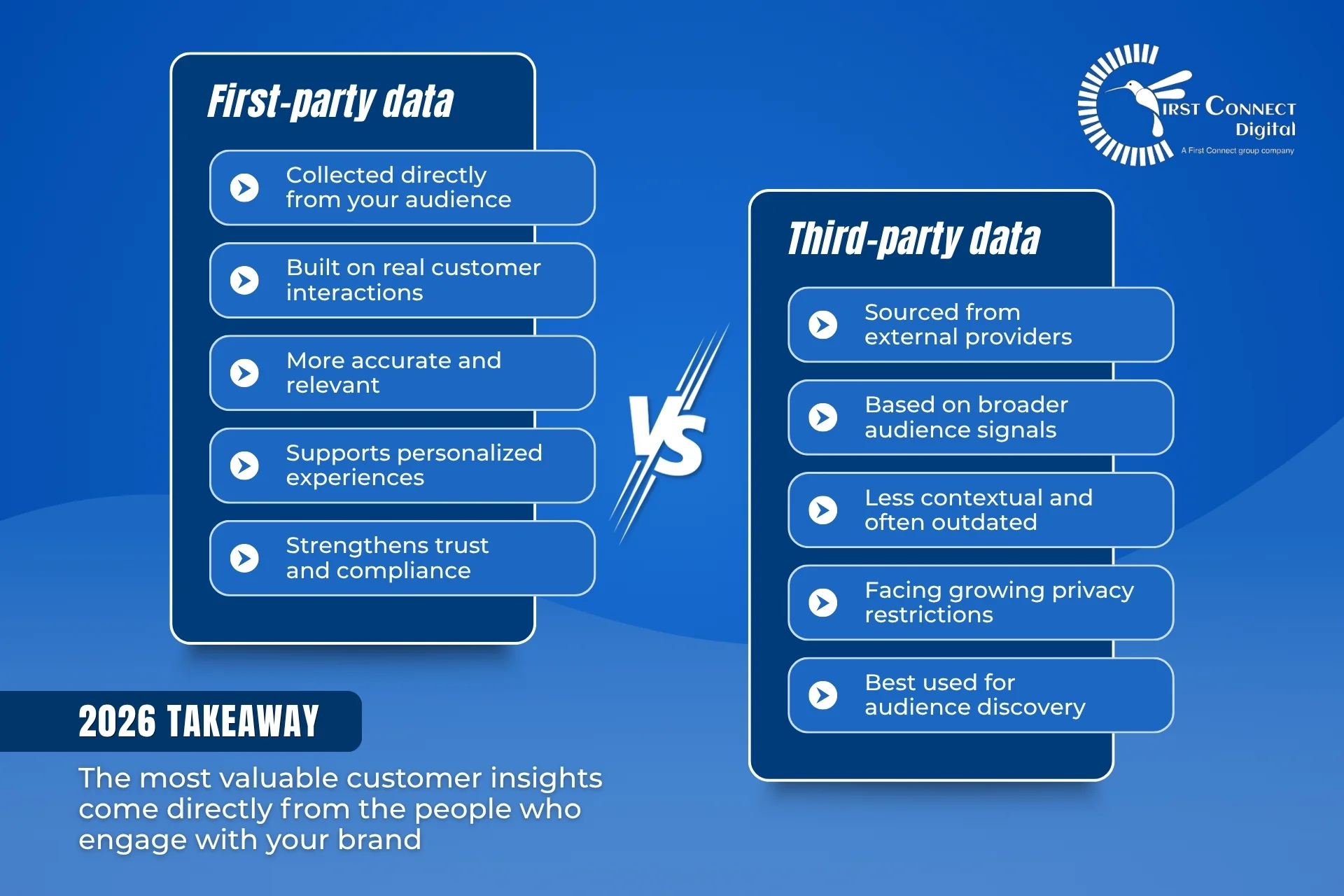
First-party data is information collected directly by your company from your own audience.
As Mailchimp describes it, this includes:
- Purchase history
- Website interactions
- Email engagement
- Customer survey responses
- And social media interaction data
All these, gathered straight from the source, with no intermediary involved.
It also encompasses CRM records, webinar registrations, product usage behavior, and any direct conversations with customers or prospects.
Because a company collects it itself, first-party data is inherently more accurate and more contextual than anything one could buy. Salesforce frames it clearly:
- How a buyer behaves with your content will always matter more than how they behave with anyone else’s.
In first-party vs third-party data, third-party data, by contrast, is aggregated by external providers from sources like websites, social platforms, loyalty programs, and public records, then sold or licensed to businesses for audience targeting and market research.
As Mailchimp notes, third-party data providers compile comprehensive consumer profiles from online activities, purchasing behaviors, and demographic sources — giving businesses access to audience segments far beyond their own customer base.
The functional difference is straightforward:
- First-party data tells you who your buyers actually are and what they actually did. Third-party data tells you who a broader audience appears to be, based on probabilistic inference from their behavior elsewhere.
Why Third-Party Data Is Losing Its Edge
For a long time, third-party data felt indispensable. It gave marketers reach and scale they couldn’t achieve on their own — the ability to target lookalike audiences, enter new markets, and run programmatic campaigns across millions of impressions.
As data privacy marketing and customer data strategy evolved, it started to lose its edge even more.
The problem is that the infrastructure supporting all of this is visibly eroding. Browser privacy controls have become more aggressive. Tracking pixels are blocked at increasing rates. Consent frameworks have made it harder for third-party data providers to legally collect the behavioral signals they once harvested freely.
eMarketer reports that B2B firms are becoming laser-focused on first-party data, with 84% of global marketers now relying on customer-provided and transactional data to derive audience insights — a significant pivot away from third-party dependency.
The quality issue compounds the legal one. Third-party data often lacks the context that makes B2B marketing effective. It can tell you that a decision-maker visited a certain category of website. It cannot tell you why, what business problem they were trying to solve, where they are in a buying cycle, or whether they are even in-market. For B2B organizations with long sales cycles and multi-stakeholder buying committees, that missing context is not a minor gap — it’s the difference between a relevant conversation and wasted spend.
None of this means third-party data is worthless. It still has a legitimate role in audience expansion, competitive research, and identifying net-new segments. But it should increasingly be treated as a supplementary signal rather than a primary data layer.
First-Party Data and the Personalization Imperative
B2B buyers no longer accept generic marketing. The expectation — shaped by years of B2C personalization and accelerated by AI-driven experiences — is that outreach should feel relevant to their specific role, company size, industry challenge, and stage in the buying journey.
Salesforce’s research on first-party data strategy offers a useful illustration of what acting on this data actually looks like in practice. Their hypothetical TechBat example shows how a company can segment its audience into meaningful groups — AI Enthusiasts who have engaged with AI content, Efficiency Seekers who have browsed productivity solutions, and loyal existing customers — and then sequence personalized messaging across email, LinkedIn ads, and content marketing, all powered by behavioral signals collected from direct interactions.
The outcomes from this kind of approach are measurable. Research cited by S2W Media shows that personalized outreach driven by first-party data produces 35% higher engagement rates, 50% better audience segmentation accuracy, and a 3x improvement in ABM targeting efficiency compared to third-party-led approaches. A McKinsey report cited in the same research highlights that businesses effectively using first-party data can generate significant revenue improvements through more precise targeting.
The personalization advantage extends beyond marketing into sales alignment. As Salesforce points out, when marketing and sales teams operate from a shared first-party data foundation — the same behavioral signals, the same engagement history, the same account intelligence — sales conversations become more relevant and the buyer experience more coherent. In B2B, where the same decision-maker may interact across a dozen touchpoints before engaging with a rep, that coherence is a genuine competitive edge.
The Five Pillars of a First-Party Data Strategy That Compounds
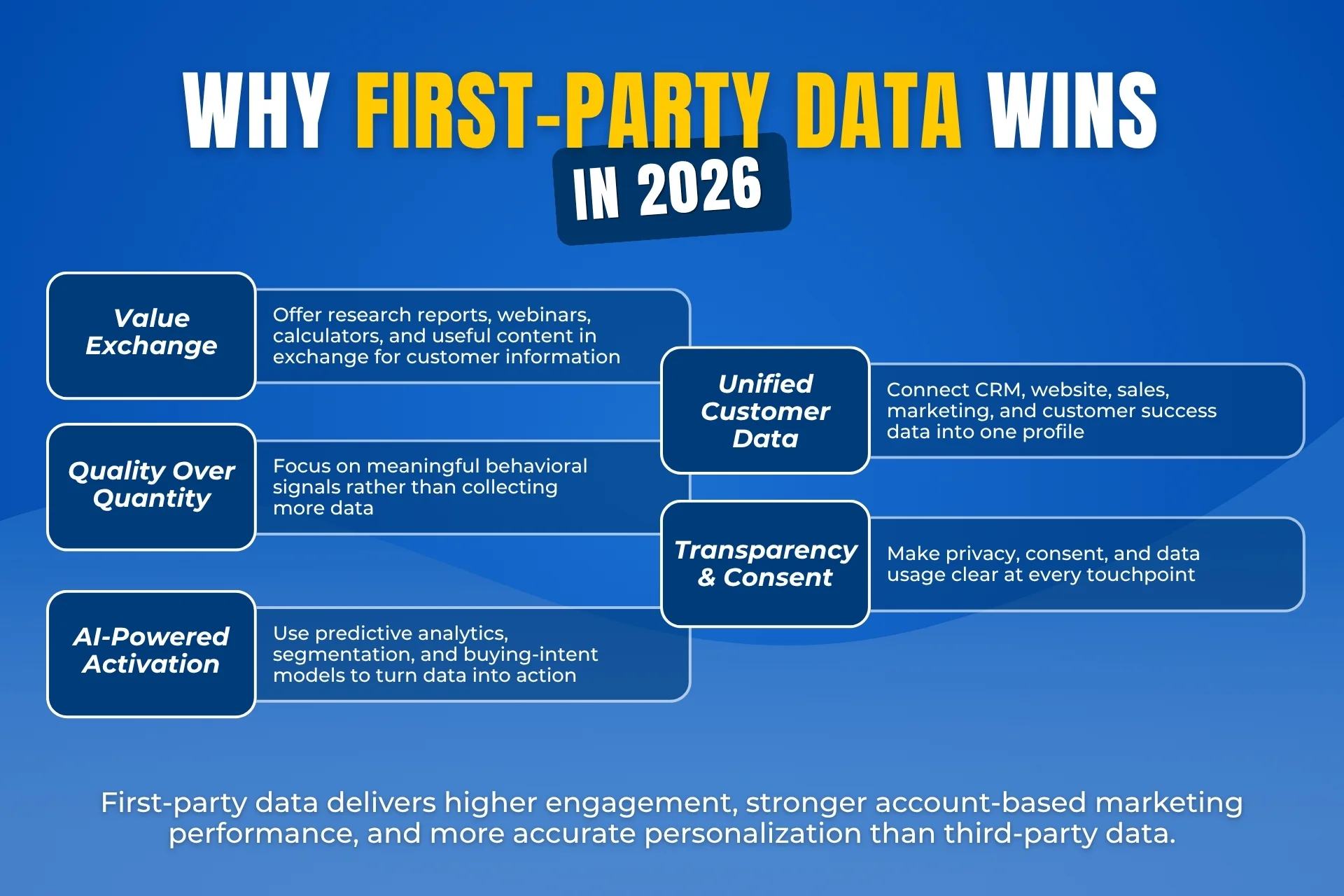
Building a first-party data capability is not a campaign. It is an infrastructure decision with long-term compounding returns. Here are five areas that determine whether a B2B organization captures that advantage or loses it.
1. Create genuine value in exchange for data
Buyers share data when they see a clear benefit. High-value content, diagnostic tools, ROI calculators, exclusive research reports, and personalized recommendations all give prospects a reason to engage and a reason to share. Salesforce’s guidance is direct: don’t ask for something for nothing. The quality of your data will improve as your value exchange improves. This is the mechanism by which trust and data capability grow together.
2. Unify data across departments
One of the most persistent structural problems in B2B organizations is data fragmentation. Marketing holds one set of engagement signals. Sales holds another in the CRM.
As Salesforce describes it, a Customer Data Platform (CDP) is the infrastructure that brings these streams together — creating a single profile of each account and enabling personalization that is consistent across the entire customer journey, not just within a single team’s slice of it.
3. Prioritize quality over volume
More data is not better data. eMarketer’s research on first-party data collection found that 78% of marketers consider behavioral intelligence signals — clicks, page views, searches, content consumption — to be impactful or extremely impactful to product discovery. But the same research found that most marketers’ data collection doesn’t yet meet their personalization goals, largely because the collection infrastructure isn’t set up to capture the right signals at the right points in the journey.
Clean, structured, well-governed data consistently outperforms large, messy, underutilized databases.
4. Build transparency and consent into the architecture, not just the legal team
The brands that will sustain first-party data programs over the long term are those where consent is not just a legal requirement but a customer experience design principle.
Salesforce lays out the core obligations clearly:
- Inform customers about what is being collected and why, offer easy opt-in and opt-out mechanisms, and demonstrate security with transparency — not just internally, but visibly to customers.
Organizations that do this well don’t just stay compliant. They also build the kind of trust that makes customers more willing to share, which creates a self-reinforcing cycle of data quality improvement. It is also an integral part of the customer data strategy.
5. Activate data with AI and predictive analytics
Collecting first-party data is table stakes. The competitive advantage lies in what you do with it. As Salesforce demonstrates, generative AI and predictive segmentation tools can now:
- Build buying likelihood scores
- Identify the next best action for specific accounts
- Create personalized ad variants for each audience segment
- And surface in-market signals earlier in the buying cycle than any manual process could detect
For B2B organizations, this is the layer that transforms first-party data from a compliance asset into a growth engine.
Where Third-Party Data Still Has a Role
It would be an overcorrection to declare third-party data irrelevant. Used selectively and responsibly, it still adds value in three specific contexts.
First, market entry and audience discovery. When entering a new vertical or geography with no existing customer base, third-party audience data can provide an initial targeting framework before you’ve had a chance to build first-party signals organically.
Second, competitive and market research. Third-party data can offer a useful macro view of industry behaviors, purchase trends, and audience demographics that your own data, by definition, cannot capture — because it reflects the market beyond your current customers.
Third, lookalike expansion. Mailchimp’s framework captures this well: third-party data enriches customer profiles by supplementing first-party data with additional demographic and behavioral insights, enabling more precise lookalike modeling for paid channels.
The key distinction is sequencing. Third-party data is most useful as a discovery layer — helping you find audiences to bring into your first-party ecosystem. Once a prospect has engaged with your content, registered for an event, or downloaded a resource, your first-party signals should take over entirely.
The Trust-Data Connection Is Not Incidental
There is something worth naming explicitly that often gets lost in the technical conversation about data infrastructure.
The shift from third-party to first-party data is not just a regulatory response. It reflects a deeper change in the buyer-seller relationship in B2B. Third-party data enabled a form of marketing that was, at its core, covert — drawing on information buyers never consciously shared with you to target them in ways they may have found surprising or intrusive.
First-party data inverts this. It is, by definition, data that buyers chose to share with you, in exchange for something they valued. That voluntary nature changes the dynamic. As S2W Media’s research on demand generation puts it, when buyers knowingly share information in exchange for value, it creates a foundation of trust — and in B2B markets with long sales cycles and high-value relationships, trust is not a soft metric. It is the precondition for every sale.
The Content Marketing Institute’s 2026 B2B research put this plainly: connect the signals you already have — CRM and behavioral data — and use them to power trust-building personalization. The emphasis on trust as the design goal, not just targeting efficiency, reflects where B2B marketing leadership is genuinely heading.
Conclusion
The first-party vs third-party data debate is, at bottom, a debate about what kind of marketing organization you want to be. One that borrows audience intelligence from external sources and accepts the uncertainty, compliance risk, and declining efficacy that come with that dependence. Or one that invests in building direct, trusted relationships with its audience and compounds those relationships into increasingly accurate, valuable, and durable customer understanding.
Both types of data have a place in a well-designed B2B marketing strategy. But the weighting has shifted decisively — and the organizations treating first-party data as a core business asset rather than a marketing tactic are the ones building the more defensible long-term position.
The data you own, earned through genuine value exchange, will always outperform the data you rent.
Key Takeaways
- First-party data is more accurate and more contextual because it comes directly from your audience’s interactions with your brand — not from probabilistic inference.
- Third-party data’s effectiveness is declining as privacy regulations tighten, browser tracking erodes, and buyers demand more transparent data practices.
- Personalization quality depends on data quality — organizations using first-party data see measurably higher engagement rates, better segmentation, and stronger ABM performance.
- A unified data infrastructure is non-negotiable — first-party data only compounds when it’s connected across marketing, sales, and customer success, not siloed by department.
- Trust is the mechanism, not just the outcome — transparent value exchange is what drives buyers to share data willingly, which is the only sustainable foundation for first-party data programs.
FAQs
First-Party vs Third-Party Data: What B2B Marketers Need in 2026
1. What is the core difference between first-party and third-party data?
First-party data is collected directly from your audience through your own channels — website, CRM, email, events. Third-party data is collected by external providers and sold to businesses for audience targeting. First-party data is more accurate, more contextual, and more privacy-compliant.
2. Is third-party data still useful in B2B marketing?
Yes, but in a diminished and more specific role. It remains useful for market entry, audience discovery, competitive research, and lookalike modeling. It should supplement first-party data, not anchor your strategy.
3. How do B2B companies collect more first-party data?
Through value exchange: gated content like research reports and ROI calculators, webinar registrations, email subscriptions, product trials, customer surveys, and personalized onboarding flows. The more genuinely valuable the exchange, the more willingly buyers share.
4. What is a Customer Data Platform (CDP) and why does it matter?
A CDP unifies first-party data from all channels — website, CRM, email, sales interactions — into a single customer profile. It is the infrastructure layer that makes cross-channel personalization and AI-driven activation possible at scale.
5. How does first-party data improve B2B personalization?
It gives marketing and sales teams visibility into what specific buyers and accounts have engaged with, what problems they appear to be investigating, and where they are in the buying cycle — enabling genuinely relevant messaging rather than broadly targeted.
6. What role does AI play in first-party data strategy?
AI transforms first-party data from a static record into a predictive asset — identifying buying signals, building propensity-to-buy scores, generating personalized content variants, and surfacing in-market accounts earlier in the funnel than manual analysis could detect.