 logo
logo



Introduction
Gartner said in 2025 that 80% of B2B sales interactions between suppliers and buyers will occur in digital channels.
According to Bombora’s intent data definition, it is buyers’ online activity data, procured ethically, indicating when buyers are actively researching online for a solution, and which products and services they are interested in, based on the web content they consume.
These insights are used by marketing and sales professionals to target the prospects who are ready to invest.
For business-to-business (B2B) companies, this insight can help boost sales, shorten the sales cycle and reduce the cost of customer acquisition.
How Intent Data Works
An important question to ask here is how intent data is collected. The section below enumerates the key points in this regard:
1. Data Collection
Vendors deploy tracking pixels and cookies across a vast network of B2B content sites, review platforms, industry publications, and media properties.
When someone at a company reads an article about cloud security solutions or downloads a whitepaper on ERP implementation, that activity is captured and tagged with a topic.
These are buyer intent signals.
2. IP Resolution & Identity Matching
The browsing activity is matched to a company (and sometimes to an individual) through IP resolution, login data, and device fingerprinting. This de-anonymizes the signal and links it to a known business entity.
3. Signal Aggregation & Scoring
Intent data in marketing helps the B2B team detect patterns in user behavior. For example, a company where five employees have consumed twelve pieces of content about a topic in two weeks is exhibiting a very different signal than one casual reader.
Vendors aggregate activity over time and score accounts by topic surge, like how much their activity exceeds their historical baseline.
4. Delivery to Your Systems
Intent signals are typically delivered via API, CSV, or native integrations into the CRM, MAP, or ABM platform, where they can trigger workflows, prioritize accounts, and inform personalization.
Types of Intent Data B2B Marketers Should Know
Mailchimp divides intent data into the following categories:
- Search
- Engagement
- Technographic
- Firmographic
1. Search
Search intent data is procured from web searches using strategies and tools like Search Engine Optimization (SEO). For example, if someone lands on the website via a Google search, one can see what keywords led them to the website from the SERP.
With a suitable plug-in, it is also possible to find what the visitors specifically look for, on repeat. At this stage, the teams have to effectively combine the data-driven plus SEO strategies to extract relevant intent data.
For example, as a software company, if you have a “Book a Demo” button on the website, a plug-in will give data as to how many visitors click on that.
Leadfeeder is a suitable tool for this.
2. Engagement
Engagement data has a stark difference from Search data. Search gets the visitor landing on the company’s platform, and engagement indicates how they interact after landing. Taking up the “Book a Demo” example again, intent data can track how long the user stays on that page after clicking.
It can also indicate if they interacted with the query form. Details on the interaction will help the B2B business leaders understand how their target audience is behaving after landing, and how many of them could be the right prospect for the campaign target.
3. Technographic Data
In B2B data targeting, technographic data captures how organizations interact with the technology tools in their stack and how those interactions shape broader buying and engagement behavior.
For example, if a prospect is actively using an integration partner’s platform or frequently engaging with a specific product feature, technographic data surfaces that activity and connects it to downstream behavior patterns.
In a B2B context, this can include CRM and MAP usage signals, software adoption patterns, API consumption, third-party tool integrations, and how teams within a target account engage with technology across their workflow.
4. Firmographic Data
Firmographic data is essentially the “demographics” of a business. For example:
- Industry vertical
- Company size
- Headcount
- Revenue
- And years in operation
In a B2B context, this data helps identify the structural profile of who is buying from you, forming the foundation of a well-defined B2B marketing strategy. B2B teams use firmographic data to define their Ideal Customer Profile (ICP), prioritize the right accounts, and filter out poor-fit prospects before investing sales and marketing resources.
Key Use Cases for Intent Data
Intent data delivers the most value when it’s mapped to a specific business outcome, not just fed into a system and forgotten. Here are the high-impact use cases for B2B teams:
1. Account Prioritization for ABM
Not every account on a target list is ready to engage. Intent data allows revenue teams to rank accounts by in-market activity, so ABM budget, content, and sales attention flows toward companies actively researching a specific category — not just ones that look good on paper.
2. Sales Prospecting & Outreach Timing
Timing is everything in B2B sales. When a target account spikes on a relevant intent topic, it gives SDRs a compelling, data-backed reason to reach out, and a relevant hook that replaces generic cold outreach with something that actually resonates.
3. Demand Generation & Content Syndication
Intent data enables precise content targeting toward companies researching a solution category, even before they’ve visited a vendor’s site. This is particularly powerful for top-of-funnel paid media, content syndication, and programmatic campaigns where relevance directly drives efficiency.
4. Competitive Displacement
When an account begins researching a competitor’s pricing, alternatives, or reviews, that’s a high-value signal. A well-timed displacement campaign, with the right message and proof points, can intercept that evaluation before a competitor wins the conversation.
5. Pipeline Acceleration
For deals already in motion, intent data adds a layer of visibility that CRM activity alone can’t provide. Accounts showing increased research activity are heating up; accounts going quiet may need re-engagement. This helps revenue teams allocate energy more effectively across an active pipeline.
6. Customer Retention & Expansion
Intent data isn’t only useful for new businesses aiming for B2B data targeting. When an existing customer begins researching competitor solutions or alternative tools, customer success teams can intervene before the renewal conversation becomes a recovery conversation — turning a churn risk into an expansion opportunity.
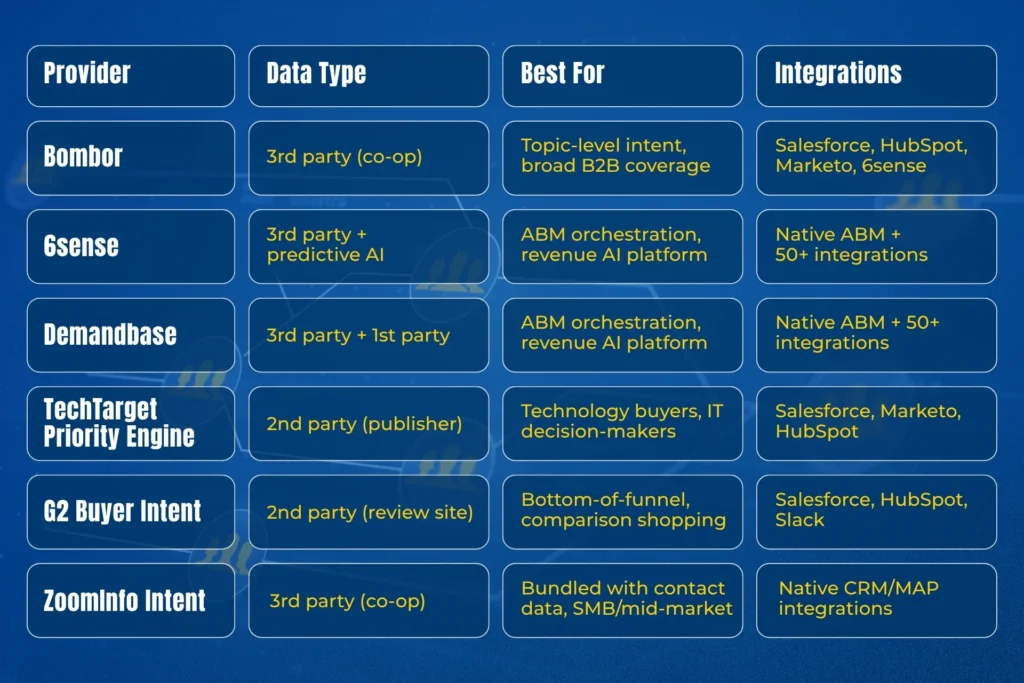
Popular Intent Data Providers & Platforms
How to Integrate Intent Data Into Your Existing Tech Stack
Intent data only generates ROI when it flows seamlessly into the tools revenue teams already use.
Here’s how it integrates across the core layers of a B2B tech stack:
1. CRM Integration (Salesforce and HubSpot)
Intent scores and topic signals can be mapped directly to account records within a CRM. Alerts can be configured for account owners when a tracked company exceeds a defined intent threshold.
Custom fields allow intent trends to be tracked over time, surfacing high-priority accounts within dashboards and lead queues, without requiring reps to manually hunt for signals.
2. Marketing Automation (Marketo, Pardot, and Eloqua)
Intent data is most powerful in marketing automation when it triggers nurture campaigns tied to specific research behavior. An account spiking on a relevant topic should enter a targeted email sequence with tailored content, not a generic drip.
Audiences can be segmented dynamically based on active intent topics, improving both relevance and engagement rates.
3. ABM Platforms (6sense, Demandbase, and Terminus)
Most enterprise ABM platforms support native intent data ingestion. Within these environments, intent signals power dynamic account segments, ad targeting logic, and account scoring models, combining first- and third-party signals into a unified orchestration layer.
4. Paid Media & Programmatic
Intent-identified account lists can be pushed to LinkedIn Matched Audiences, Google Customer Match, and display DSPs. Serving relevant ads to people at companies showing in-market signals significantly improves advertising efficiency and message relevance. Thus, reaching the right accounts at the right moment in their buying journey.
5. Sales Enablement (Outreach, Salesloft, and Slack)
Intent alerts integrated into sales engagement platforms give reps real-time notifications with full context. For example, the account, the topics being researched, and suggested content or talking points to use in outreach.
This removes the lag between a signal being generated and a rep acting on it, which is often where intent value is lost.
Challenges and Limitations of Intent Data
Despite the positive ROIs, there are some drawbacks to intent data. Before investing, tech leaders and CMOs must be aware of them:
1. Signal Noise and False Positives
Not every search has an intent. Hence, intent data, even after a well-rounded insight, could be a false positive.
Getting back to the same example cited above, if a user lands on a website and clicks on the “Book a Demo” page, it does not mean that it is a real intent. It could be a product owner of a rival software company or a software developer researching.
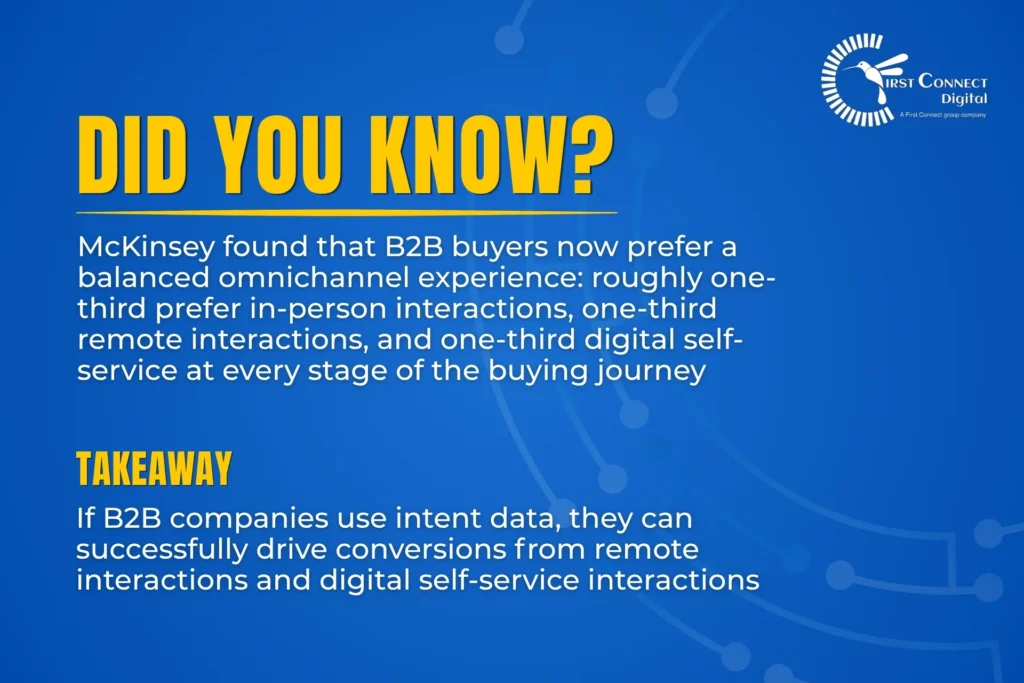
Did you know?
According to Forrester research, 92% of B2B buyers begin their journey with at least one vendor already in mind.
2. Incomplete Individual-Level Resolution
Most third-party intent data identifies the company, not the specific person. Knowing the account is in-market is valuable, but finding the right contact still requires additional data and research.
3. Data Freshness and Latency
Intent signals can be days or weeks old by the time they reach your system. Buying cycles move fast — stale data can lead to outreach that arrives too early or too late in the journey.
4. Privacy Regulation Compliance
GDPR, CCPA, and evolving global privacy laws add complexity to how intent data can be collected, processed, and used — particularly for individual-level signals in regulated markets.
5. Vendor Data Quality Variance
The quality and breadth of intent data vary enormously between vendors. Match rates, topic taxonomies, and network coverage differ widely — always validate with a proof-of-concept before purchasing.
6. Over-Reliance Risk
Intent data is an input, not a strategy. Over-relying on intent signals can create a reactive posture that chases in-market accounts while neglecting early-stage demand creation, which creates tomorrow’s in-market buyers.
Best Practices for Using Intent Data Effectively
1. Start With ICP Fit as a Non-Negotiable Filter
In-market signals from the wrong accounts are wasted effort. Before acting on any intent signal, it should be cross-referenced against the Ideal Customer Profile criteria, like:
- Industry
- Company Size
- Revenue
- Tech Stack
- And Geography
Intent data amplifies targeting precision; it doesn’t replace fit qualification.
2. Layer Multiple Signals for Higher Confidence
A single intent signal is a hint. A cluster of signals is more valuable. Look for:
- Third-party topic surges
- First-party website activity
- Review site visits
- And CRM engagement history
These are buying indicators. Accounts showing intent across multiple sources convert at significantly higher rates than those flagged by a single data point alone.
3. Align Sales and Marketing Before Activating
Sales and marketing must work in unison for an effective intent data strategy. The roles are different, but the guidelines must be shared.
Here is a crucial step that proves helpful: Shared account scoring thresholds, agreed SLAs for follow-up on intent spikes, and consistent messaging frameworks should be established before any intent-driven program is launched
4. Personalize Outreach Around the Signal
Knowing what a prospect is researching is only valuable if that knowledge is reflected in the outreach. Messaging that references the topic a company is actively exploring will always outperform a generic sequence. The intent signal should directly inform the subject line, the content offer, and the sales hook.
PwC found that customers are willing to pay up to a 16% price premium for a great customer experience.
5. Measure Incrementally to Prove ROI
Running intent-driven campaigns alongside control groups is the most reliable way to isolate the impact of intent data on pipeline, win rates, and deal velocity. Without this measurement discipline, it’s difficult to justify continued investment or optimize performance over time.
6. Refresh the Topic Taxonomy Regularly
The language buyers use to describe their problems evolves with the market. Intent topics that were relevant twelve months ago may no longer capture the full range of in-market behavior. A regular review of tracked topics ensures signals stay aligned with how the category is actually being researched.
7. Treat Intent Data as an Input, Not a Strategy
The most common mistake is treating a high intent score as a trigger for immediate aggressive outreach. Intent data should inform a coordinated, multi-channel response, not replace the judgment of the sales and marketing teams acting on it.
The signal tells teams where to focus, and the strategy determines how.
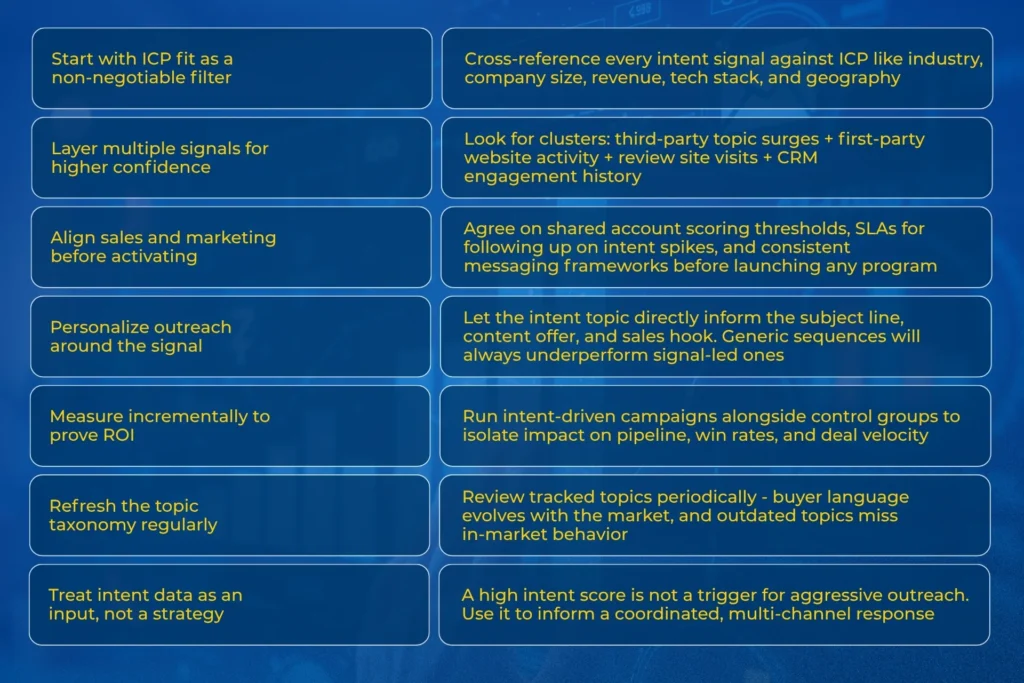
A table summarizing the points above:
Conclusion
As B2B global operations evolve, so do their allied industries. Hence, tools and platforms offering intent data are evolving too. This is increasingly coupled with strategies like demand generation and SEO-led initiatives.
The long-term success depends on the processes, alignment, and measurement discipline built around the data.
As buying journeys grow more complex and self-directed, the ability to identify and act on in-market behavior at the right moment will only become more critical to sustainable pipeline growth.
Key Takeaways
- Intent data works best when layered with ICP fit scoring. In-market signals from the wrong accounts generate noise and false positives.
- First-party intent data (owned behavioral signals) consistently outperforms third-party data in accuracy and trust — building that foundation should come before investing in external vendors.
- Sales and marketing alignment around shared scoring models and response playbooks determines whether intent data drives revenue or simply sits in a dashboard.
- Intent data is an input, not a strategy — the teams getting the most value from it are those who have built structured, automated workflows that translate signals into timely, personalized action.
Frequently Asked Questions (FAQs)
Intent Data in Marketing
1. What is the difference between first-party and third-party intent data?
First-party intent data is collected from a company’s own properties, like its website, LinkedIn metrics, white paper downloads, and more. The third-party intent data is gathered from external networks, mostly paid channels that track user behavior outside the owned digital properties.
However, Mainchimp divides intent data into these categories: Search, Engagement, Technographic, and Firmographic.
2. How accurate is intent data for identifying potential buyers?
Intent data is valuable. It offers insights that fast-track sales and shorten the sales cycle. However, it is not without drawbacks. It may give signal noise, which may lead the sales team to pursue the wrong lead.
3. Can intent data be used for small and mid-sized businesses (SMBs)?
Intent data deployment started at the enterprise level because of the high budget. However, with the democratization of technology, the SMBs too can reap the benefits of intent data.
4. Is intent data compliant with privacy regulations like GDPR and CCPA?
Yes. However, B2B companies must check compliance with every platform they subscribe to.