 logo
logo




Most B2B sales reps spend their days chasing the wrong leads.
They work through lists built on job titles and form fills, follow up manually, and hope the pipeline holds. Meanwhile, the high-intent buyer who visited the pricing page three times this week still hasn’t received the right offer to drive conversion.
However, the good news is that this gap is closing fast.
As of Q1 2026, 61% of B2B teams now use AI for lead scoring, up from just 23% in 2024. The shift isn’t about adding automation. It’s about detecting intent earlier, responding faster, and keeping outreach relevant at scale. 74% of revenue leaders believed in 2025 that improving pipeline quality, not pipeline volume, is their top priority.
This article breaks down exactly how that works: where traditional lead generation falls short, how AI changes each stage of the funnel, and what real implementations actually look like in practice.
Why Traditional B2B Lead Generation Is Ineffective
Traditional lead acquisition depends on three key actions:
- List building
- Broad targeting
- Follow-ups
The teams deploying the traditional method are stuck in mediocrity when it comes to qualified leads. Many B2B teams still rely on a campaign-launch-and-wait model:
- Deploying outreach, holding for form submissions, then moving leads through manually built workflows that hinge on individual execution.
But this model does not solve a crucial problem. What happens the moment pipeline volume scales, channels diversify, or speed-to-response emerges as a competitive differentiator?
How AI Empowers Lead Generation in B2B Industries
Gartner says that by 2028, 90% of B2B buying will be AI agent intermediated, pushing over $15 trillion of B2B spend through AI agent exchanges.
AI solves this problem in three essential parts:
First,
AI helps identify the right leads. This is done by predicting visitor behavior, routing inbound requests, and fast-tracking conversion with a personalized, conversational experience.
Second,
With the help of AI, repetitive tasks can be automated. AI also helps process large sets of data, much faster than a human can. For example, with the right deployment, it can summarize long notes, categorize inbound and outbound leads, detect patterns, and create insights from the engagement data on all customer touchpoints.
Third,
With the first and second steps streamlined, AI enables the team to focus on high-value prospects. In a B2B setting, awareness of high-value leads plays a crucial role in shortening the sales cycles.
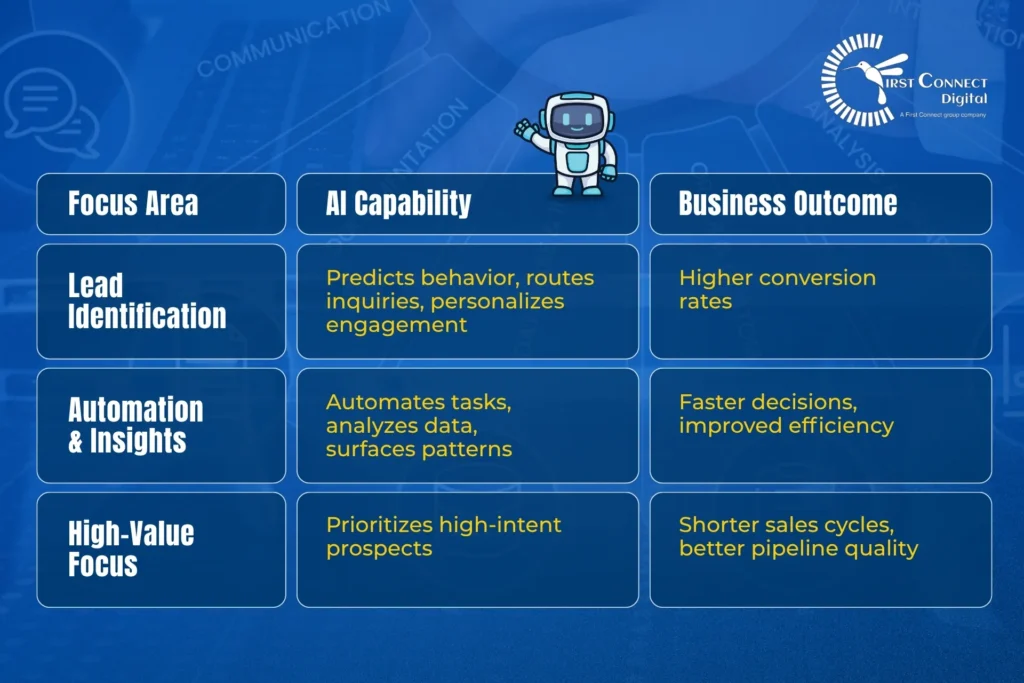
The table below summarizes the points above:
| Focus Area | AI Capability | Business Outcome |
| Lead Identification | Predicts behavior, routes inquiries, personalizes engagement | Higher conversion rates |
| Automation & Insights | Automates tasks, analyzes data, surfaces patterns | Faster decisions, improved efficiency |
| High-Value Focus | Prioritizes high-intent prospects | Shorter sales cycles, better pipeline quality |
AI is reshaping how B2B organizations manage awareness, consideration, and conversion by enabling faster alignment between the right message, the right buyer, and the right moment.
How AI Transforms Each Stage of B2B Lead Generation
Role of AI in each stage of the funnel:
- Awareness Stage
At the awareness stage, the goal is to surface relevant solutions before the buyer has fully defined their need.
In this stage, the main goal is to bring forth a solution, even before the buyers are fully aware of their needs.
In the B2B context, AI helps the teams to detect early signals. Based on these signals, the sales team can devise an outreach plan in the form of content. This ensures prospects encounter messaging that aligns with their emerging needs from the very first interaction.
Takeaway for B2B Teams: Earlier engagement with higher relevance, leading to stronger top-of-funnel performance.
- Consideration Stage
72% of B2B buyers say they only engage with personalized communications tailored to their needs or industry.
B2B teams use AI to personalize messaging, case studies, and proof points based on industry, role, or behavior. The solution remains consistent, but how it is framed adapts to what is most likely to resonate with each prospect.
Takeaway for B2B Teams: Faster evaluation cycles driven by more relevant and contextualized information.
- Conversion Stage
At the conversion stage, speed and clarity are critical for the B2B sales team to close an increasing number of clients. In B2B lead generation, AI offers both speed and clarity by removing bottlenecks at the point of decision.
It can:
- Recommend the next step (such as booking a demo or scheduling a consultation)
- Automate responses
- Ensure prospects can act immediately without delays
Takeaway for B2B Teams: Higher conversion rates and shorter sales cycles through frictionless decision-making. An important observation to note here:
AI-assisted SDR programs reduced cost-per-meeting from $312 to $94 in 2026 cohorts. However, pure-AI programs without human handoff produced 41% lower meeting-to-opportunity conversion, making hybrid setups the clear winner.
How HubSpot Implemented Lead Scoring at Scale
HubSpot is a known brand in the CRM software industry, catering to B2B teams globally. It is designed to help them with automation.
However, as their customer base scaled, the company faced a major issue:
- Its sales reps were spending significant time on leads that had little likelihood of converting, while high-intent prospects were not always reaching the top of the queue.
How did HubSpot solve this problem?
They built a predictive model for lead scoring, powered by Machine Learning. The model evaluated hundreds of behavioral and firmographic signals, like:
- Page visits
- Email engagement
- Content downloads
- Company size
- Industry
The outcome was meaningful. Here are some points to note:
- Internal data showed that teams using AI-assisted lead scoring saw approximately 40% improvement in MQL-to-SQL (Marketing Qualified Lead to Sales Qualified Lead) conversion rates.
- Sales reps were redirected toward the accounts most likely to move, while automated nurture sequences handled lower-intent contacts.
The greatest lesson B2B teams can take from here is that AI models must not be introduced in the solution but embedded in the CRM workflow. Reps continued working the same, but with better insight to target the right accounts.
The advantage goes beyond automation. It lies in earlier intent detection and more precise, data-driven decision-making.
A useful way to understand this is by looking at how Netflix uses Machine Learning to guide users from discovery to action.
While not a traditional B2B lead generation model, the underlying mechanics are highly relevant:
- Identifying intent signals
- Personalizing engagement
- Reducing friction to drive decisions
1. Identifying Intent Signals
Netflix does not wait for users to indicate intent only after they search. Here is everything the platform tracks:
- What a user pauses on
- How long they hover over a title
- What they skip
- When they watch
- And on which device
2. Personalizing Engagement
Once intent is detected, Netflix does not serve the same experience to every user. It adapts what each person sees at the visual level, not just at the content level.
One of the most concrete examples of this is its artwork personalization system.
According to Netflix, thumbnails account for over 80% of viewing decisions, and the same show can look completely different to two different users, with the image selected based on each person’s historical interactions with similar visual cues, using a combination of collaborative filtering, content-based filtering, and deep learning models.
For B2B teams, this principle translates into personalizing the message, not just the channel. AI allows outreach to be framed differently for a CFO versus a Head of Operations, even when the underlying solution is identical.
3. Reducing Friction to Drive Decisions
Netflix found that users who started watching within 60–90 seconds were significantly more likely to complete shows, so the platform is built around reducing the time between opening the app and actually watching content, with autoplay, prominent “Continue Watching” rows, and smart categorization all working together to eliminate hesitation. These same principles apply directly to modern lead generation funnels in B2B industries.
Key AI Tools Powering B2B Lead Generation
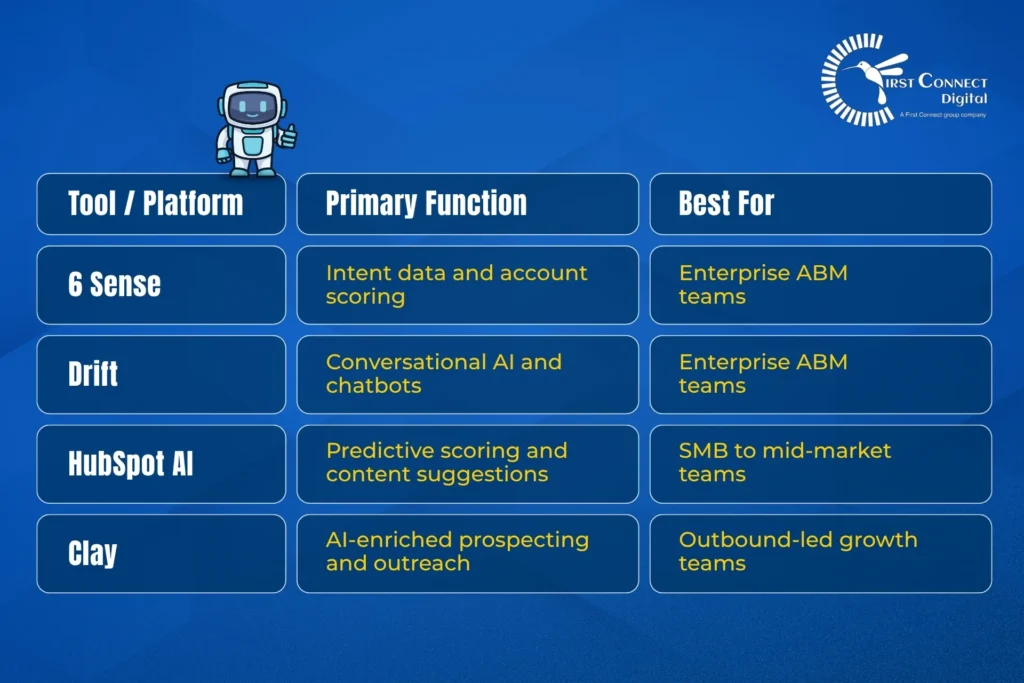
The AI-powered lead generation market has expanded significantly. Below is a reference-level overview of the platforms most commonly deployed by B2B revenue teams in 2026:
| Tool / Platform | Primary Function | Best For |
| 6sense | Intent data and account scoring | Enterprise ABM teams |
| Drift | Conversational AI and chatbots | Enterprise ABM teams |
| HubSpot AI | Predictive scoring and content suggestions | SMB to mid-market teams |
| Clay | AI-enriched prospecting and outreach | Outbound-led growth teams |
The right selection depends on team size, existing CRM infrastructure, and whether the priority is inbound qualification, outbound prospecting, or account-based targeting.
Many mature B2B teams combine two or three of these tools, each handling a distinct stage of the funnel.
How to Build an AI-Powered B2B Lead Generation System
The biggest problem in AI deployment is that B2B teams assume AI as a single tool and evaluate it in isolation. Whereas its strength lies in its integration as a sequenced system.
Below is a guide for the step-by-step implementation of the AI in CRM:
Step 1: Define the Signal Layer
Before selecting any platform, map the behavioral and firmographic signals that historically correlate with conversion in your pipeline. These typically include:
- Job title
- Company size
- Industry
- Pages visited
- Content downloaded
- Email engagement patterns
Also, B2B organizations that align sales and marketing teams achieve 24% faster revenue growth and 27% faster profit growth over three years. (Forrester, 2023). Hence, an alignment between the two teams is an important sub-step here.
Step 2: Choose the Right Intelligence Layer
The main step here is to match the signal map to the selected platform’s data. If your funnel is inbound-dominant, a conversational AI platform or CRM-native scoring tool is the right starting point.
If pipeline generation depends on outbound prospecting in target accounts, an intent data platform such as 6sense or Bombora is more appropriate.
Step 3: Integrate Directly Into the Sales Workflow
AI that lives in a separate dashboard outside the rep’s daily workflow will not drive adoption. The scoring output, intent alerts, and recommended actions must surface inside the tools reps already use.
This could be any tool, such as Salesforce, HubSpot, Outreach, and Salesloft.
Step 4: Measure Intent-to-Pipeline Velocity
Traditional lead generation is measured by volume: MQLs, form fills, and open rates. AI-powered systems require a different measurement framework.
Track intent-signal-to-opportunity time, pipeline coverage from AI-sourced accounts, and the conversion rate of AI-scored leads versus non-scored leads. These metrics make the system’s ROI visible within the first quarter of deployment.
Looking Ahead
The global lead generation industry is projected to reach $295 billion by 2027, growing at an estimated 17% CAGR.
AI integration started with enterprises integrating it into their workflow. Today, AI deployment has trickled down to SMBs
The key step is to identify where the point of friction is in qualified lead acquisition and apply AI to smooth that out. Platforms like HubSpot AI, 6sense, and others mentioned in the article are well-suited, depending on the goal.
81% of organizations that deployed AI tools report measurable improvement in pipeline velocity within six months.
Key Takeaways
- AI accelerates the funnel. The awareness-consideration-conversion framework remains valid. AI makes each stage faster, more targeted, and more measurable.
- By the time a prospect fills out a form, they have already shortlisted vendors. AI-powered intent detection allows B2B teams to enter the conversation earlier, when the decision is still being shaped.
- As Drift’s data demonstrates, the gap between a high-intent signal and a sales conversation directly influences close probability. AI eliminates that gap.
- The highest-performing B2B teams embed AI outputs directly into the tools reps already use. Standalone AI dashboards consistently underperform because they create an additional step rather than removing one.
- The clearest ROI comes from identifying a single bottleneck — whether that is inbound qualification, outbound targeting, or conversion friction — and deploying AI to solve that specific problem before expanding the system.
Frequently Asked Questions (FAQs)
AI Is Transforming B2B Lead Generation
Q1. How does AI lead scoring differ from traditional lead scoring?
Traditional lead scoring relies on a point system based on job title or page visits. AI-powered lead scoring trains machine learning models on historical conversion data to surface patterns that human analysts would miss.
The result is a dynamic score that updates in real time as new behavioral signals come in, rather than a static rule set that requires manual recalibration.
Q2. How long does it take for AI lead generation tools to show results?
Most AI scoring and intent platforms require a data calibration period of four to eight weeks before the model's recommendations become reliably accurate.
Conversational AI tools, by contrast, can show pipeline impact within the first two to four weeks of deployment because they operate on real-time visitor behavior rather than historical pattern matching.
Q3. Is AI lead generation suitable for SMBs or only for enterprise teams?
AI lead generation tools are now available across all market segments. CRM-native tools like HubSpot AI and Clay are specifically designed for smaller teams with limited technical resources.
Enterprise platforms like 6sense and Salesforce Einstein are built for large revenue organizations with complex account hierarchies.
The right entry point depends on current pipeline volume and the stage of the funnel where conversion loss is greatest.