 logo
logo




TL;DR
|
Enterprise marketing teams have spent years optimizing for reach: bigger lists, broader campaigns, higher MQL counts. The underlying assumption is that quantity reliably predicts quality. For B2B organizations selling complex, high-value solutions, that assumption was always fragile. The data now makes it untenable.
Research affirms that 76% of marketers believe account based marketing delivers a higher return on investment than any other marketing strategy. That figure is not a product of novelty or enthusiasm —it reflects a structural advantage.
Account-Based Marketing (ABM) concentrates resources on accounts most likely to generate revenue, rather than distributing spend across audiences that mostly will not. For C-suite leaders frustrated with a pipeline that looks healthy until it collapses at close, ABM is a system-level fix, not another campaign layer.
The Core Premise: Why It Challenges Comfortable Habits
ABM inverts traditional demand generation logic. Instead of casting wide and filtering later, you define the accounts worth winning before a single dollar is spent on outreach. Marketing and sales then coordinate every motion around winning those specific accounts.
That inversion forces three organizational changes most teams underestimate:
- Sales and marketing must agree on what a good account looks like before any campaign launches. A shared ideal customer profile built on real win/loss data, not gut instinct or sales team preference.
- Success metrics shift from volume to velocity and conversion. According to Gartner, ABM increases overall pipeline conversion rates by 14% and drives a 25% improvement in MQL-to-sales-accepted-lead conversion. Those outcomes require measuring at the account level, not the lead level.
- Resources concentrate rather than distribute. ABM demands investing more per account in exchange for a better-fit pipeline. Organizations used to spreading budgets across broad digital lead generation campaigns often resist this trade-off initially, and then wonder why their pipeline quality doesn’t improve.
These are not cosmetic changes. They require executive sponsorship, cross-functional accountability, and a willingness to hold marketing to revenue outcomes rather than activity metrics.
How ABM Programs Are Actually Structured
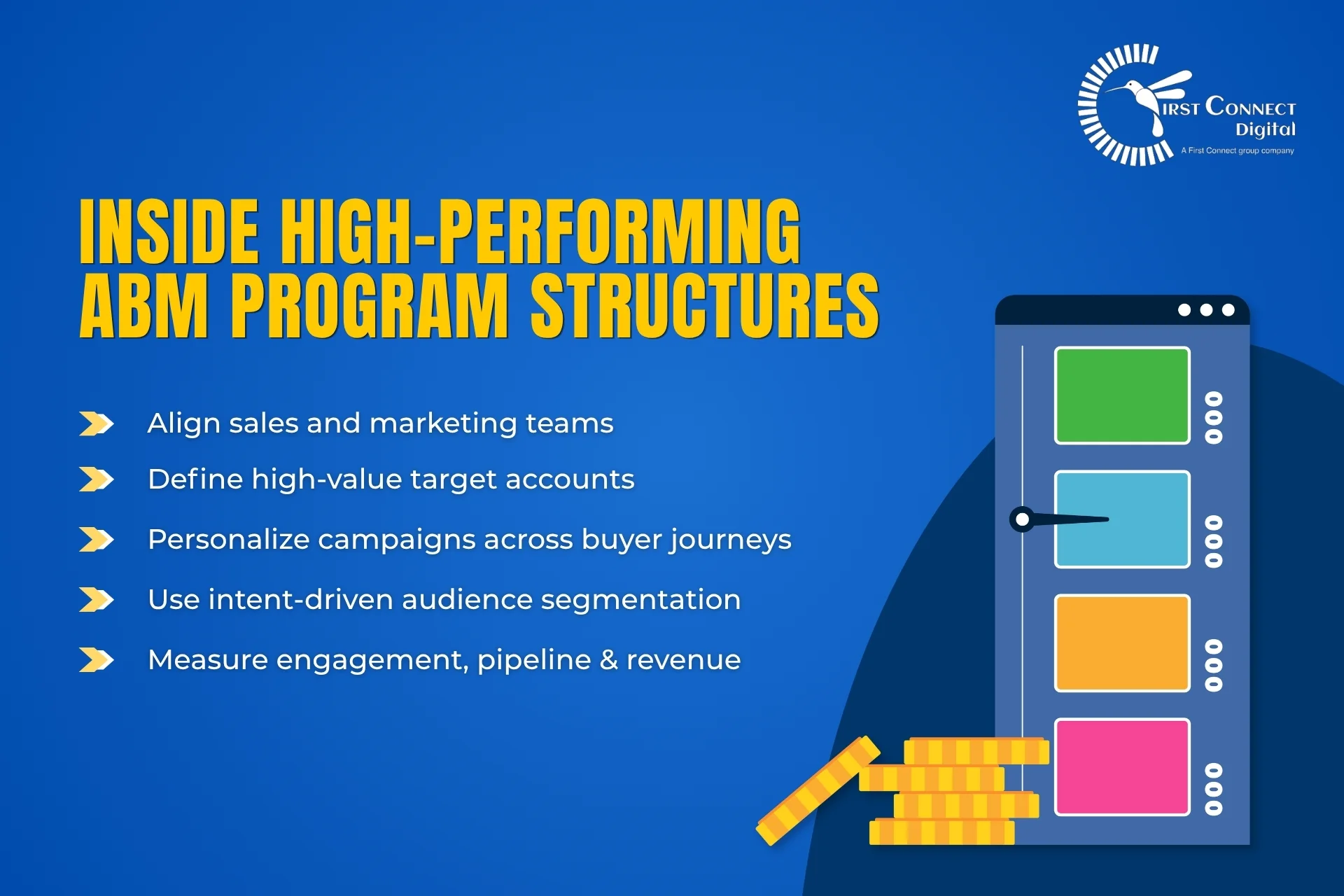
The industry has converged on a tiered approach to ABM that allocates effort proportionally to account value. According to ABMLA data, one-to-one campaigns average around 39 target accounts, one-to-few campaigns around 177, and one-to-many programs often extend to 6,000 or more. Understanding where your resources belong across these tiers is the first real strategic decision in any ABM build.
Tier One: High-Touch, One-to-One ABM
At the top tier sit the accounts where a single win would be transformational: a platform relationship, an industry anchor client, or a deal size that justifies deep pre-sale investment. Programs at this level are highly customized: account-specific research, tailored content, executive alignment strategies, and personalized event experiences. The collaboration between marketing and sales is continuous, not episodic. Budgets per account are significant, and the return justifies it. Companies with fully aligned ABM strategies report 208% more revenue from key accounts than those using conventional methods, per SiriusDecisions research.
Tier Two: Segment-Level, One-to-Few ABM
The middle tier targets clusters of accounts sharing meaningful characteristics, including vertical, technology stack, comparable company size, or a shared business trigger such as a recent funding round or regulatory change. Content and messaging are personalized at the segment level rather than the individual account level. A financial services firm mid-way through a cloud migration receives fundamentally different outreach than a manufacturer evaluating its first enterprise software deployment. This is where account based marketing services that combine data, activation, and reporting in a unified workflow create the most operational leverage.
Tier Three: Programmatic ABM at Scale
The broadest tier extends the ABM framework across a larger named-account universe using programmatic digital advertising, automated content personalization, and AI-driven sequencing. At this scale, manual coordination collapses. The programs that succeed here have invested in data quality first and built AI-powered lead generation infrastructure capable of managing account-level logic across thousands of simultaneous targets without degrading relevance.
The Data Layer That Makes ABM Work
No amount of strategic alignment compensates for poor data. This is where most ABM programs quietly underperform. The culprit is rarely strategy or messaging. but because the underlying account data is fragmented, outdated, or inconsistent across systems. According to a 2024 industry analysis, data quality issues hinder 62% of ABM implementations. Marketing sees one version of an account; sales sees another. Intent signals arrive in a report nobody acts on in time.
Effective ABM data infrastructure supports four non-negotiable functions:
| Function | What It Enables |
| Unified account record | A single source of truth shared across sales, marketing, and customer success |
| Buying committee mapping | Identifying which roles are engaged and which gaps in coverage need to be closed |
| Intent data integration | Real-time behavioral signals feeding directly into outreach prioritization |
| Account-level attribution | Understanding which channels and interactions are influencing pipeline |
Buying committee mapping deserves emphasis here. Gartner research puts the average B2B buying decision at 6 to 10 stakeholders. An ABM program that reaches one contact at a target account while five decision-influencers go untouched is structurally incomplete, regardless of how good the messaging is.
Intent data is equally consequential. When a target account matching your ICP shows intensified research around a problem your solution addresses, that buyer intent signal is worth acting on the same day, not when the data surfaces in a monthly review. Teams that operationalize intent data marketing in real time, routing signals directly into sales workflows and marketing sequences, consistently outperform those treating it as a reporting input.
First Connect Digital builds its ABM delivery model around this operational layer. By combining enriched firmographic data with real-time intent signals, their account based lead generation programs surface which accounts are actively in-market rather than simply which accounts fit the profile on paper. That distinction matters enormously when sales team capacity is finite and every outreach decision has an opportunity cost.
Where AI Changes the ABM Equation
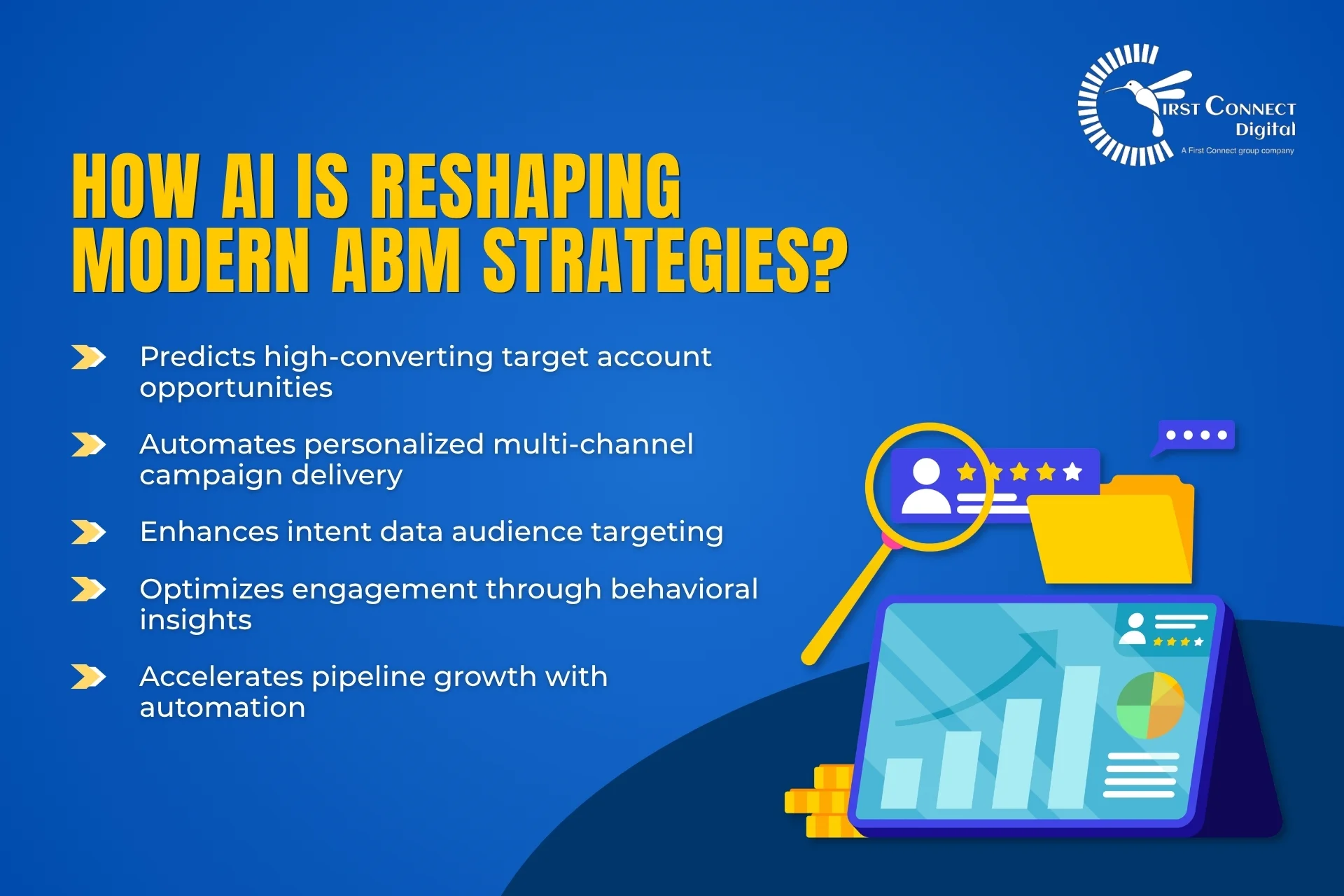
Artificial intelligence is reshaping ABM execution, and the most consequential applications are not the most obvious ones. The value is not in generating content faster. It is in making prioritization, sequencing, and channel coordination decisions that no human team can manage at scale.
- Predictive Account Prioritization
Traditional lead scoring assigns points based on demographic fit and surface behavioral signals. Predictive models trained on historical win data, enriched with third-party intent signals, identify which accounts are most likely to convert and when. The practical result is that sales teams stop spending time on accounts that look right on paper but show no active buying motion.
According to a 2024 analysis, mature ABM programs using AI in lead generation see 5 to 9 times ROI on average, compared to roughly 3x for programs still relying on static scoring models. Lead generation AI at this level is not about replacing seller judgment. It is about giving that judgment sharper inputs
- Multi-Channel Orchestration
Omnichannel execution is where ABM separates from traditional demand generation in measurable terms. Research shows omnichannel ABM outreach, coordinating email, LinkedIn, phone, and paid media, leads to 234% faster pipeline progression compared to single-channel approaches.
The challenge is coordination at account scale: suppressing ads to accounts already in an active sales conversation, triggering content sequences when intent signals spike, adjusting messaging based on live engagement data.
AI-driven multi-channel online marketing solutions handle this sequencing logic in ways that manual campaign management simply cannot replicate across a named account list of any meaningful size.
- Personalization That Earns a Response
80% of B2B buyers say personalized content makes them more likely to convert, and 71% expect it in outreach, per CMI research. But personalization that merely inserts a company name into a subject line is not the same as messaging that reflects genuine understanding of an account’s business context, strategic priorities, and specific buying trigger.
AI powered lead generation workflows accelerate production; human editorial judgment determines whether the output meets the standard sophisticated buyers are expecting. Programs that skip the editorial layer tend to produce personalization that feels automated, and sophisticated buyers notice.
Events as an Integrated ABM Channel
One underutilized component of enterprise ABM programs is coordinated event strategy. Whether the format is an executive roundtable, a hosted webinar, a targeted seminar, or a large-scale conference, events create engagement depth that digital channels rarely achieve independently. According to Forrester, 65% of companies report that ABM programs increase pipeline opportunities, quality, or both. Event-sourced pipeline, when properly integrated into the ABM account framework, contributes disproportionately to that outcome.
The mistake most organizations make is treating events as separate from ABM rather than as a channel within it. When invitation strategy is built around the target account list, when attendee selection is driven by account fit and intent data, and when follow-up sequences are triggered by event engagement rather than generic post-event email blasts, the return on event investment improves substantially. Webinar lead generation and seminar lead generation, when architected around ABM account criteria, produce a different quality of pipeline than broad promotional approaches. Social media event promotion and targeted event advertising, deployed against a known account universe, compound that impact further.
First Connect Digital’s event promotion services are built with this integration in mind, connecting event outreach directly to the account intelligence layer so that outcomes from events are measurable against the same revenue standards as every other program component.
A Practical Roadmap for Enterprise ABM Adoption
Phase 1: Foundation (Months 1–2)
- Define and validate the ICP using win/loss data and cross-functional alignment between sales and marketing
- Audit existing data quality and identify contact coverage gaps at priority accounts
- Select the tier structure and size the account list accordingly
Phase 2: Infrastructure (Months 2–4)
- Integrate intent data feeds and establish account-level scoring logic
- Align CRM and marketing automation to support account-level pipeline reporting
- Build buying committee maps for Tier One accounts
Phase 3: Execution (Months 4–6)
- Launch coordinated outreach across channels for priority account tiers
- Activate programmatic advertising against the broader named account list
- Deploy appointment generation workflows for accounts showing high intent
Phase 4: Optimization (Ongoing)
- Measure pipeline influence and closed-won conversion by account tier
- Adjust account prioritization based on live engagement and intent data
- Expand segment playbooks that are working; retire those that are not
One important calibration: fewer than 20% of companies report that their ABM program is fully embedded in the business, and only 29% consider their strategy fully optimized.
The organizations that will extract the most from ABM in the next few years are those treating it as a continuous operating rhythm rather than a quarterly campaign cycle. Teams that perform best keep adjusting account intelligence, buying committee coverage, and channel mix as conditions evolve.
Looking Ahead
Account-based marketing is not new, but the precision with which it can now be executed, using intent data, AI lead generation prioritization, and multi-channel orchestration, has genuinely changed what is practically achievable.
For enterprise leaders, the strategic case is well-documented: 87% of ABM practitioners report positive ROI, deal sizes are measurably larger, and sales cycles are shorter when programs are run with discipline.
The organizations that will lead their markets are those committing now to the data driven marketing infrastructure, cross-functional alignment, and orchestration discipline that ABM demands.
Key TakeawaysABM is a structural fix, not a tactical add-on: Running ABM alongside an unreformed volume-based demand generation engine produces marginal results. The model works when it replaces the measurement system, not just the campaign format. The data layer determines whether the strategy holds: Firmographic accuracy, contact coverage across the buying committee, and live intent signal integration are prerequisites, not enhancements. Intent data changes the timing equation: Knowing which accounts fit your ICP and which of those accounts are actively in-market right now is what determines whether your outreach arrives at the right moment or gets ignored. AI matters most in prioritization and orchestration: The leverage from AI in ABM is not content generation speed. It is the ability to manage sequencing logic, account scoring, and channel coordination at a scale no human team can replicate manually. Measurement is where most programs fall short: Only 52% of companies track ROI from their ABM programs. Without account-level attribution tied to closed revenue, the program cannot be optimized and cannot be defended to leadership. |
FAQs
Account-Based Marketing
1. How is ABM different from traditional B2B lead generation and appointment setting services?
Traditional lead generation services prioritize volume and filter for fit afterward. ABM identifies and qualifies target accounts before outreach begins, concentrating investment where it matters most. The result is lower lead volume but substantially higher conversion rates and average deal size.
2. What role does intent data play in an ABM program?
Intent based marketing surfaces behavioral signals indicating that a specific account is actively researching a problem your solution addresses. Integrating it in real time allows teams to prioritize outreach toward accounts that are in-market right now, not just accounts that fit the profile.
3. How long does it take to see results from an ABM program?
Most enterprise ABM programs produce measurable pipeline influence within four to six months, with full revenue impact typically visible at the nine-to-twelve month mark. 87% of ABM practitioners report achieving positive ROI within six months, per industry data. Programs calibrated to short-cycle lead volume expectations will consistently underestimate the model's actual output.
4. Can ABM work for organizations without large in-house marketing teams?
Yes. A well-structured Tier Two or Tier Three program using intent data, precision targeting, and automated personalization can be executed efficiently without a large internal team. Partnering with specialized account based marketing solutions providers like First Connect Digital gives organizations access to the data infrastructure and execution capability of a mature ABM program without having to build every component from scratch.