 logo
logo




Most B2B sales teams are not losing because their pipeline is too small. They are losing because they cannot tell which leads in that pipeline are actually worth chasing.
AI today has solved that issue, and the solution is what B2B marketers call predictive lead scoring.
According to McKinsey & Company, generative AI could unlock an incremental $0.8 trillion to $1.2 trillion in productivity across sales and marketing, with leading use cases including opportunity prioritization, personalized outreach, and AI-assisted selling.
The qualification problem has persisted for years, but the cost of getting it wrong is accelerating. Buyers are moving faster, competition is denser, and sales cycles that drift beyond three months are quietly killing revenue.
The traditional response of building a bigger list, running more sequences, generate more MQLs is producing diminishing returns because it addresses volume, not fit.
What is changing in 2026 is the ability to solve this problem at scale. Artificial intelligence, and specifically AI-driven predictive lead scoring, is giving B2B teams something they have never had before:
- A real-time, continuously improving signal of which prospects are ready to engage, and which ones are not worth a single sales rep’s attention yet.
However, in implementation there is a major gap:
- According to McKinsey’s B2B Pulse Survey, while a wide majority of commercial leaders show willingness to adopt advanced digital solutions, only 20% of respondents report a proven track record of consistently implementing technologies that fuel outsize growth.
That gap between awareness and execution is precisely where B2B companies are leaving the most margin on the table.
What is the Core Problem With B2B Leads Scoring Today
Traditional lead scoring is built on a flawed premise that a prospect’s identity tells something about their readiness to buy.
The typical rules-based model works like this:
- A VP of Operations at a 300-person manufacturing firm downloads a whitepaper. The system awards 15 points.
- She opens three emails over a fortnight, another 10.
- She attends a webinar, 20 more.
- By the time she hits 60 points, she’s routed to a sales rep as an MQL, even if she opened those emails out of curiosity.
- Further, she has no active budget cycle and is two years away from an actual purchasing decision.
Meanwhile,
- Another prospect at a similar company is six weeks into an active vendor evaluation, visiting your pricing page repeatedly.
- Comparing you against two competitors.
- Consuming every case study on your site.
Under a point-based model, that person might score lower because she hasn’t clicked on an email sequence.
This misalignment is systemic.
Research consistently shows that only 27% of leads sent to sales by marketing teams are actually qualified for sales engagement. The majority of marketing-qualified leads fail to convert into customers without better scoring mechanisms. This is not because the leads are inherently wrong, but because qualification criteria are built around marketing convenience, not buyer behavior.
The result is the following:
- Wasted rep time, inflated CPL, and a sales and marketing relationship that runs on mutual frustration rather than shared signal.
How AI Lead Scoring Upgrades Traditional Lead Scoring
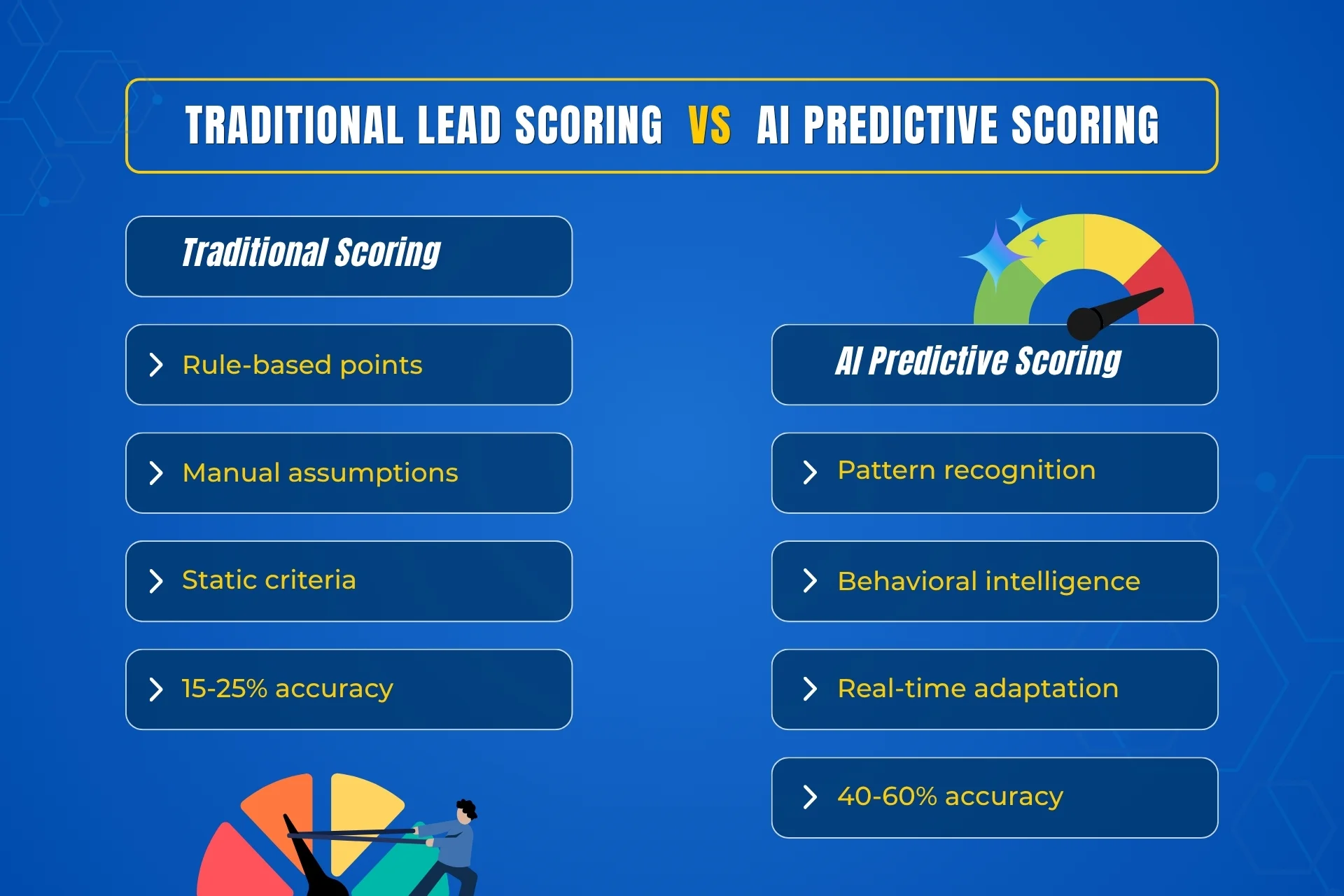
AI lead scoring does not simply add more variables to a points table. It rebuilds the scoring logic entirely around patterns, not rules.
Where a rules-based model says that a whitepaper download is worth 15 points, a machine learning model asks which combination of signals, across which timeframe, across which buyer profile, has historically preceded a closed-won deal?
The answer is usually far more nuanced and far more predictive than any manually constructed scoring rubric.
The inputs AI models draw from are substantially richer and fuction as better sales intelligence tools.
They combine:
- Firmographic data (company size, industry, revenue band)
- Behavioral data (page visits, content engagement, email interaction patterns)
- Intent data (topic surges across third-party publisher networks, competitor research on review platforms)
- And historical CRM data (which past deals closed, at what deal size, after how many touchpoints).
The model identifies the intersections that actually predict conversion, not the intersections that look plausible on a whiteboard.
McKinsey identifies AI-powered opportunity identification and personalization as two of the five most critical ways B2B sales leaders are pulling ahead of competitors today.
Companies that outperform on growth are investing more aggressively in digital-led transformations and AI to boost sales and marketing productivity, and those that master innovation see an additional 4% points of cumulative total shareholder return growth compared to peers who do not.
The scoring benefit compounds across the funnel. Research shows that companies implementing AI-supported lead scoring see, on average, 38% higher conversion rates from lead to opportunity, alongside 28% shorter sales cycles through focusing on high-quality leads.
Manual scoring models achieve 15-25% accuracy in predicting which leads will close. AI lead scoring reaches 40-60% accuracy.
How Generative AI Is Extending the Advantage Further
AI-driven lead scoring identifies who to prioritize. Generative AI is now changing what happens next.
According to McKinsey’s research on gen AI in B2B sales, the technology is enabling sellers to engage customers at the right moments with contextually relevant messaging by pulling together insights from corporate websites, earnings calls, CRM history, and real-time behavioral signals.
One of the highest-value gen AI use cases identified in McKinsey’s analysis is the smart research assistant — a tool that can assist sellers with real-time fact-finding during live calls, reducing the time reps spend scrambling for context and improving the quality of customer interactions.
Organizations like a large global logistics provider have already deployed gen AI voice analytics tools to analyze thousands of sales calls, identifying the key reasons customers declined purchases, the agent behaviors most correlated with successful conversions, and the specific language patterns that preceded cancellations.
That is the practical meaning of AI in B2B sales: not a futuristic concept, but a workflow already deployed by commercial leaders who are pulling ahead of peers who are still debating whether to start.
The ROI Comparison: AI-Driven Scoring vs. Traditional Qualification
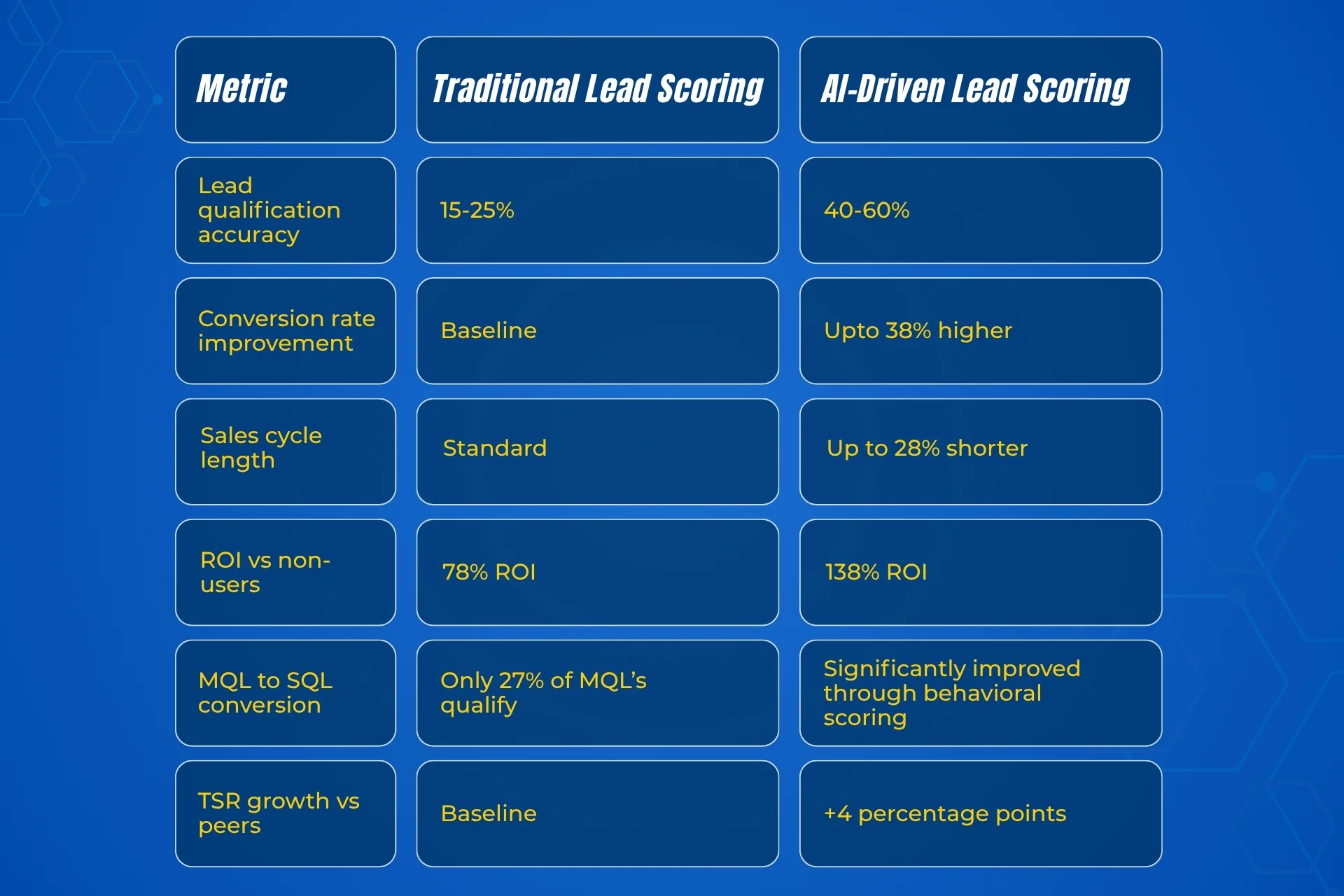 The most direct way to evaluate this is against the metrics that determine B2B revenue outcomes.
The numbers are directionally consistent regardless of source and signify that AI-powered prioritization improves conversion rates, shortens cycles, and produces higher ROI.
The learning for B2B leaders: The issue is not whether AI lead scoring works. The evidence base for that is established. The issue is activation, meaning whether teams embed it into live workflows or leave it as a reporting layer that nobody acts on.
A Real-World Scenario
Consider a B2B SaaS company selling supply chain visibility software. Under a traditional model, the SDR team works a 500-account list segmented by company size and vertical. Every account receives the same cadence — three emails over two weeks, a LinkedIn connection request, and a cold call.
Now layer in AI-driven lead scoring.
The model surfaces nine accounts that, combined, are showing surging intent around supply chain disruption, real-time inventory tracking, and ERP integration flexibility.
Three of those accounts have had multiple decision-makers visiting competitor pricing pages in the past ten days. Two have had employees engaging with peer reviews, comparing vendors in the category.
These nine accounts are not necessarily the most obvious ones on the list by firmographic criteria alone. But they are the accounts actively in-market right now.
The SDR who calls those accounts this week is entering a conversation the buyer is already having internally.
The SDR working through the rest of the list with generic outreach is not. That difference in timing and relevance is where AI’s ROI advantage is generated.
A Checklist for Deploying AI Scoring
AI lead scoring is not a plug-and-play solution. Several constraints apply in practice.
1. Data quality determines model quality
A machine learning model trained on unorganized CRM data will produce unreliable scores. Most B2B teams underestimate how much data preparation is required before a model can be trained effectively. HubSpot’s own guidance suggests a floor of at least 500 contacts and three months of historical outcome data before a predictive model returns reliable results.
2. Models need maintenance
AI scoring is a backward-looking system because it learns only from historical patterns. When a company shifts its ICP upmarket, launches a new product line, or changes its sales motion, the historical correlations that trained the model may no longer apply.
Scores generated by a model trained on last year’s deals will be systematically wrong for a new-strategy pipeline. Adobe’s Marketo team recommends treating lead scoring as a model you review and iterate on quarterly at a minimum — not a one-time build you set and forget
3. Score decay matters
A pricing page visit from six months ago is not the same signal as one from last week. Models that do not apply decay logic to behavioral signals will surface leads based on stale intent — undermining the core value of real-time prioritization.
4. Activation determines outcome
McKinsey’s research is clear that most B2B leaders recognize the potential of AI but have yet to fully engage with it. The gap between organizations extracting measurable ROI from AI lead scoring and those that do not is largely a gap in implementation depth.
Teams that embed AI scores directly into CRM workflows, sales sequences, and campaign prioritization see compounding returns.
Conclusion
The shift from volume-based lead generation to AI-driven scoring is not a technology decision. It is a strategic revenue decision. B2B teams that continue to treat all leads as equal will keep losing ground to competitors who know exactly which accounts are in-market, why, and when to reach out.
The tools to close that gap are no longer out of reach. What separates the teams extracting measurable ROI from those still waiting for results is not access to better data. Rather, it is the discipline to embed that data into how sales and marketing actually work, every day.
Key Takeaways
- Traditional lead scoring describes who prospects are. AI scoring reveals when they are ready – The ROI gap between rule-based and AI-driven qualification is fundamentally a timing and accuracy gap — reaching the right account at the right behavioral moment generates compounding returns across every funnel stage.
- Volume metrics will mask AI’s impact – Evaluating AI-driven scoring against raw MQL volume understates its effect. Pipeline velocity, lead-to-opportunity conversion rate by source, and sales cycle length by lead origin are the metrics that make the difference visible.
- Gen AI extends the advantage beyond identification – AI scoring tells you who to contact. Generative AI changes what happens when you do — enabling reps to enter conversations with contextual intelligence that would have taken hours to compile manually, and to engage at the moment of highest buying readiness.
- Most of the competitive advantage is still unclaimed – McKinsey’s B2B Pulse Survey confirms that only 20 percent of companies report consistently implementing technologies that fuel outsize growth. That means the field is open for organizations willing to go from intent to execution on AI-driven commercial capabilities.
- Implementation quality is the limiting factor, not technology access – The tools exist. The data is available. What separates B2B organizations extracting ROI from those still waiting for results is whether AI outputs are embedded into how reps actually work — or left in a system no one opens between quarterly reviews.
FAQs
Predictive Lead Scoring
1. How is AI lead scoring different from intent data?
Intent data identifies which accounts are actively researching topics relevant to your category across the web. AI lead scoring ingests intent signals as one input among many — alongside firmographic fit, behavioral engagement, CRM history, and more — and produces a composite prediction of conversion likelihood. Intent data tells you something is happening. AI scoring tells you what it means relative to your specific sales context and history.
2. How much data does a B2B team need before AI scoring is reliable?
Most practitioners recommend a minimum of 500 contacts with known outcomes and at least three months of behavioral history before training a meaningful model. The more historical closed-won and closed-lost data you can feed the model, the more accurate its predictions become. Smaller teams can start with hybrid models that combine AI recommendations with rules-based logic.
3. How long before AI lead scoring produces measurable ROI?
Most deployments require four to eight weeks of model calibration before recommendations reach reliable accuracy. Teams tracking the right metrics — conversion rate by scored versus non-scored leads, pipeline velocity, and sales cycle length by lead source — typically see measurable impact within the first quarter of full deployment.
4. Can AI lead scoring and traditional scoring coexist?
Yes — and for most teams, a phased approach is the most practical path. Rules-based scoring continues to handle obvious qualification filters (wrong company size, wrong geography, competitor employees). AI scoring adds a predictive layer that prioritizes within the qualified pool based on behavioral and intent signals. Over time, as the model accumulates more outcome data, the rules-based layer can be simplified.
5. Where does gen AI fit in the lead scoring workflow?
Gen AI most commonly enters after scoring — helping reps personalize outreach based on the behavioral context that drove the high score, preparing sellers for live calls with account intelligence, and drafting follow-up materials tailored to what a specific account has been researching. McKinsey identifies smart research assistance and personalized outreach generation as among the highest-value gen AI use cases for B2B sales teams in 2025 and beyond.