 logo
logo


B2B lead generation strategies for SaaS companies have undergone a structural shift. The old model was – maximize volume, hand it to sales, let the funnel sort it out, but this is no longer viable.
Today’s SaaS buyers are more informed, more self-directed, and more impatient than ever before. Here are some numbers to note in this regard:
- According to Gartner’s Future of Sales research, 80% of B2B sales funnel interactions now occur in digital channels.
- A separate Gartner survey of 632 B2B buyers conducted in 2024 found that 61% actively prefer a rep-free buying experience — and that 73% avoid suppliers who send irrelevant outreach, with bad prospecting actively damaging future relationships.
- Meanwhile, McKinsey’s B2B Pulse research shows that B2B buyers now engage across an average of ten channels throughout the buying journey.
- According to 6Sense’s 2024 Buyer Experience Report, buyers are already nearly 70% through their purchasing process before they engage with a seller for the first time.
This changes everything about how SaaS companies should approach lead generation. It is no longer a top-of-funnel numbers game.
Rather, it is now a precision exercise which includes:
- Identifying the right accounts at the right moment.
- Building trust through content and experience.
- And aligning marketing, sales, and product around a shared definition of a quality lead.
This article is called the ‘ultimate guide’ as it breaks down the strategic foundations, channel-by-channel playbook, emerging 2026 trends, and key metrics that separate SaaS companies with scalable, compounding lead generation engines from those still chasing volume.
Step-by-Step Guide to SaaS Lead Generation
Not all SaaS lead generation is created equal. SaaS presents a unique challenge. The buying cycle is long, the decision-making committee is large, and the cost of a wrong-fit customer is high. On top of that, the product itself should solve a crucial problem.
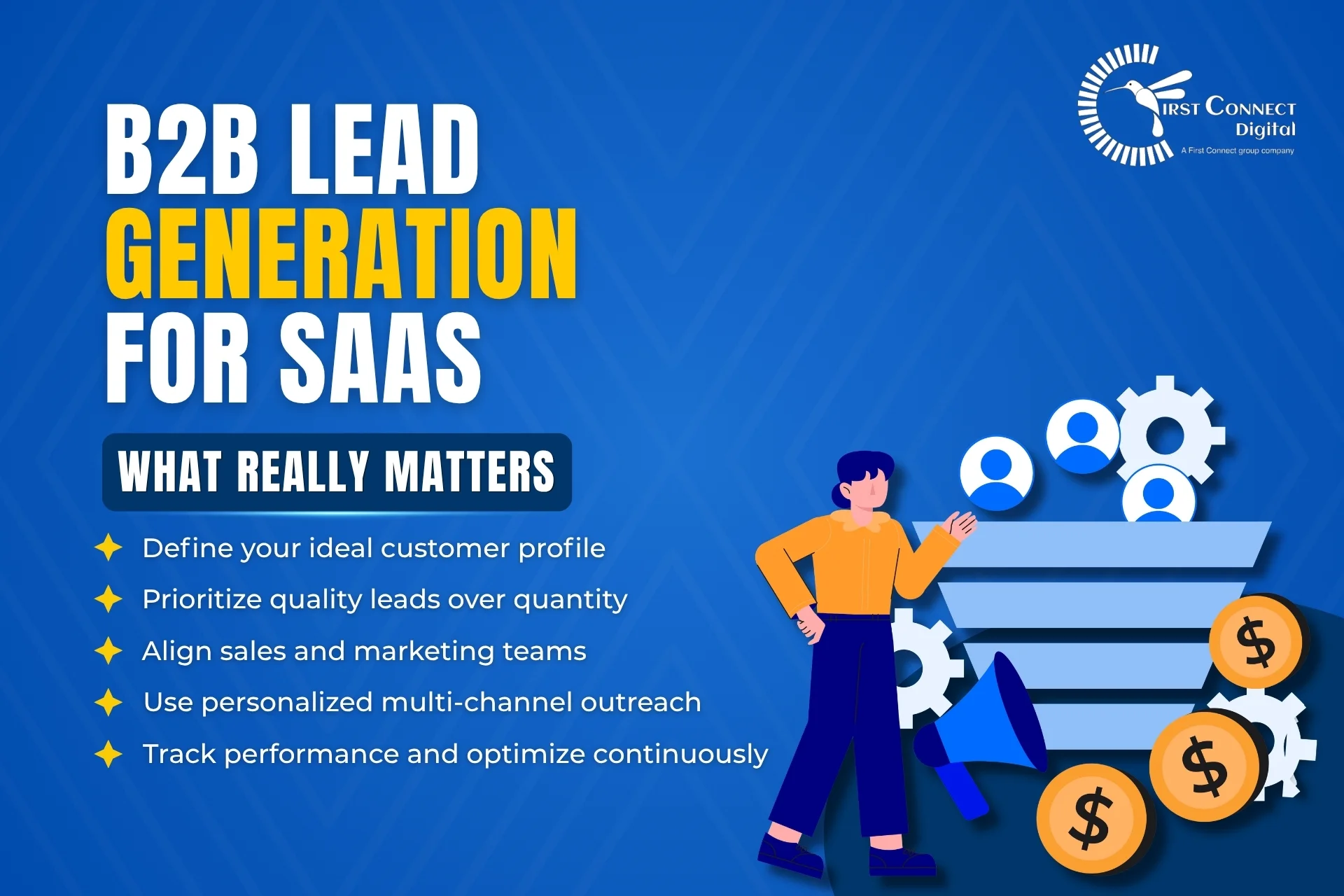
1. Define Your Ideal Customer Profile Before Running a Single Campaign
The most common and costly lead generation mistake in SaaS is launching campaigns before clearly defining who they are for. An Ideal Customer Profile (ICP) is not a target persona. It is a precise, data-backed definition of the accounts most likely to buy, activate, expand, and stay.
A well-constructed ICP for lead generation for startups and enterprises include:
- Industry vertical and sub-sector specificity
- Company size range (headcount and revenue), not a broad bracket
- Technology stack signals like what tools they already use that indicate fit or readiness
- Buying triggers, like the business events (hiring surges, funding rounds, product launches, compliance deadlines) that correlate with purchase decisions
- Decision-maker roles and the structure of the buying committee for that account type
Without a defined ICP, the campaigns attract noise. Forrester research shows that companies using advanced account selection criteria see 33% higher average deal sizes than those relying on basic firmographic data alone.
2. Sales and Marketing Alignment is Non-Negotiable
The most persistent structural failure in B2B SaaS lead generation strategies is the disconnect between sales and marketing. Marketing generates leads by one definition. Sales rejects them using another. Neither team updates its approach. The pipeline fills with MQLs that never move, and both teams attribute the failure to the other.
The fix is not a better handoff process. It is a shared operating model built around four agreements:
a. Shared ICP Definition:
Which accounts are in scope for outreach and nurture? Prevents sales from chasing accounts marketing never intended to attract.
b. Lead Qualification Criteria:
What signals constitute an MQL, SQL, and PQL? Eliminates disputes at handoff and creates a common language.
c. SLA for Follow-Up:
Maximum response time from MQL to first sales touch. Research shows that responding within 5 minutes is 21x more likely to qualify a lead versus waiting 30 minutes (HubSpot).
d. Feedback Loop Cadence:
Regular sessions where sales reports on lead quality. Allows marketing to continuously refine targeting and messaging.
3. Content is Your Most Scalable Sales Asset
Because buyers are nearly 70% through their journey before engaging a salesperson, content does the majority of the qualification and persuasion work long before a sales conversation begins.
| Marketers who prioritize blogging are 13x more likely to achieve a positive ROI on their efforts. — HubSpot |
Now, content could be mistaken for a high volume of content. In 2026, the content that gets ranked on Google SERP and other primary search engines must be quality pieces of content that answer crucial questions decision makers have. Here are some content areas that marketing managers emphasized:
- Case studies that map customer outcomes to specific pain points.
- Interactive tools like ROI calculators, product maturity assessments, and readiness diagnostics.
- Technical documentation, white papers, and integration guides that address the relevant questions.
- Webinars and live demos that allow buyers to evaluate fit on their own terms, without committing to a sales call.
| Brands using content as a lead driver see up to 6x higher conversion rates than those who do not. 76% of businesses credit content marketing with higher lead volume. — Forbes |
Where to Find High-Intent SaaS Leads
There is no single platform that can magically populate the pipeline. It is a combination of four to six channels, discussed below:
1. SEO-Driven Content Marketing
Organic search remains the highest-ROI lead generation channel in B2B SaaS. HubSpot’s State of Marketing report consistently ranks website, blog, and SEO as the number one source of lead generation ROI for B2B brands.
2. LinkedIn
75% of B2B buyers use LinkedIn to inform purchase decisions (LinkedIn, 2025).
This is a reliable platform to target mid-market and enterprise decision-makers. LinkedIn is both a paid and organic channel for lead generation. The platform is precise in targeting leads via filters that narrow down the company size, job function, seniority and technology stack. Its flagship product, Sales Navigator, helps companies narrow down the most relevant accounts for cold pitches.
3. Email Marketing and Personalised Nurture Campaigns
Email remains among the highest-converting channels in B2B, but only when executed with an effective strategy.
Generic broadcast email is not lead generation but fatigue.
High-performing SaaS email programs share several characteristics, discussed below:
- Triggered sequences based on behavioral signals. These include what content a prospect consumed, which pages they visited, and what product feature they explored in a free trial
- ICP-segmented messaging that speaks to the specific challenges of a particular industry or role, not a generic value proposition
- Minimal, focused calls to action.
| Did you know? 73% of the best-performing lead generation emails contain just one or two clear CTAs (Databox). |
4. Product-Led Growth (PLG)
In SaaS, the product itself is often the most powerful lead generation tool available. Free trials, freemium models, and self-serve demos allow potential customers to experience value before any sales conversation occurs.
5. Account-Based Marketing (ABM)
ABM has crossed from an enterprise-exclusive strategy to a mainstream SaaS practice. Rather than generating leads from a broad audience, ABM B2B lead generation strategies invert the model as follows:
- Define the target accounts first, then execute personalized, multi-channel campaigns to engage and convert them. 87% of B2B marketers say ABM delivers a higher ROI than other marketing strategies (ITSMA).
ABM works at its best when intent data is layered on top of the target account list — surfacing which accounts are actively researching a solution category right now, not just which ones look good on paper.
6. Paid Advertising
Paid channels like LinkedIn Ads, Google and Meta ads remain relevant but require a fundamentally different orientation than broad awareness campaigns.
High-performing SaaS paid ads target high-intent keywords, align ad messaging directly to buyer pain points, and optimize for conversion quality, not click volume.
Conclusion
The companies winning in 2026 are not those with the biggest B2B lead generation strategies or lead generation budgets. They are those who have built the clearest picture of who their best customers are, invested in the content and channels that reach those accounts before a formal evaluation begins, and created the internal alignment to convert interest into revenue efficiently.
Lead generation is not a top-of-funnel problem. It is a whole-company capability — one that compounds when built on the right foundations, and stagnates when treated as a volume exercise.
Key Takeaways
- ICP precision is the multiplier – Every channel performs better when you have a sharply defined target. Define it before launching campaigns, not after.
- Sales and marketing alignment is a revenue metric – Forrester’s research shows aligned firms report 2.4x higher revenue growth. Shared qualification criteria and regular feedback loops are the operational mechanism.
- Content does the majority of the qualification work – Buyers are nearly 70% through their journey before first contact. Your content strategy is your sales strategy for the part of the funnel you cannot attend.
- PLG is the highest-efficiency lead generation model available to SaaS companies – PQLs convert at 25% versus 5–10% for traditional MQLs. If your product can be experienced before a sales call, it should be.
- Intent data separates timely outreach from noise – Adding behavioural intent signals to MQL criteria improves MQL-to-SQL conversion from 9.8% to 16.4%. The signal tells you where to focus; the strategy determines what to do.
- Metrics must connect to revenue, not activity – Track CPL, MQL-to-SQL conversion, CAC, LVR, and NRR. If a metric does not connect to a revenue outcome, it is not a lead generation metric.
FAQs
B2B lead generation
1. What is B2B lead generation in SaaS?
B2B lead generation strategies in SaaS refer to the process of attracting and converting businesses that are likely to benefit from a software product into potential customers through channels like SEO, LinkedIn, email marketing, and product-led growth.
2. Why is an Ideal Customer Profile (ICP) important for SaaS companies?
An ICP helps SaaS companies focus on high-fit accounts that are more likely to convert, retain, and expand, improving both marketing efficiency and sales outcomes.
3. Which lead generation channel works best for SaaS businesses?
There is no single best channel. Most successful SaaS companies combine SEO, LinkedIn, email nurture campaigns, ABM, and PLG strategies to create a scalable lead pipeline.
4. Why is content marketing important for SaaS lead generation?
Content marketing helps SaaS companies educate buyers, build trust, and answer key questions before a sales conversation begins, making it one of the most effective long-term lead generation strategies.