 logo
logo


TL;DR
|
Introduction
Think about the last time you interacted with a brand across multiple platforms. Maybe you saw their LinkedIn post, visited their website a few days later through a Google search, and then received an email from them without them having any idea that you’d already been to the site twice. It felt a little off. Right?
That gap between being present on more than one channel and actually connecting those channels is exactly what makes the difference between omnichannel vs multichannel marketing. Although the terms are often used interchangeably by many people, there are very distinct, different marketing strategies behind them, and the differences in those two types of strategies can have a direct impact on your business.
This is where the discussion around omnichannel vs multichannel marketing becomes important. According to Salesforce’s State of the Connected Customer Report, which states 79% of customers expect consistency when interacting with agents across departments, yet most businesses still struggle to deliver connected experiences.
At the same time, the data from McKinsey & Company’s research on personalisation found that leading organisations/businesses earn 40% more revenue from their personalisation efforts than their average competitors.
This shift is changing how businesses engage with their customers. Instead of simply being active on multiple platforms to engage customers, brands are now expected to create smooth and connected customer journeys through omnichannel strategies.
What Is Multichannel Marketing?
Multichannel marketing refers to using multiple channels to engage with customers.
These channels may include:
- Websites
- Email Marketing
- Social Media
- Paid Ads
- SMS Campaigns
- Mobile Apps
The main goal of multichannel marketing is to increase brand visibility by reaching users wherever they are spending their time online.
In multichannel marketing, each platform usually has its own independent system. A business may, for example, run Email marketing, SEO blogs, and Social Media or digital ads at the same time, yet the experience for the customers will almost certainly differ from one channel to the other; they may not feel connected across those channels.
Key characteristics of Multichannel Marketing include:
- Each channel is managed independently with its own strategy and metrics
- Customer data is often contained in a silo and not shared across channels
- Inconsistencies in messaging across customer touchpoints
For example, if a customer interacts with a brand through Instagram, they might receive a completely generic email since the customer data is not being shared properly between systems.
Though this approach still works well for many small businesses that wish to build brand awareness and support the lead generation process for their customers, larger companies and more sophisticated digital marketers typically do not use multichannel marketing.
What Is Omnichannel Marketing?
Omnichannel marketing uses the same channels but connects them into one unified experience for customers by using data from each channel to personalise their experiences. To accomplish this, instead of focusing only on visibility, omnichannel marketing focuses on continuity and personalisation, providing customers with multiple choices in how they can interact with a brand across different channels.
Core principles of Omnichannel marketing include:
- All customer interactions should be tracked as well as shared across platforms
- Messaging and offers will change depending on where the customer happens to be in their journey
- The experience is seamless whether it happens to be in-store, through mobile, or online
- Customer data flows freely between different systems in real time
For example, a customer may browse through an app, receive personalised email recommendations, continue on their desktop computer to the point of purchase, and finally, check out and make a purchase in-store, creating a connected experience across all of those channels because the customer was tracked throughout the process.
The goal isn’t simply to be on more channels, but to create a sense of connection at each point of interaction with customers, so a customer never has to restart their engagement.
According to Adobe Experience Cloud’s omnichannel guide, omnichannel marketing is an extremely powerful way to market your company by providing your customers with seamless interactions from their computers, mobile devices, and they can have access to the same customer data whether they are in-store or online.
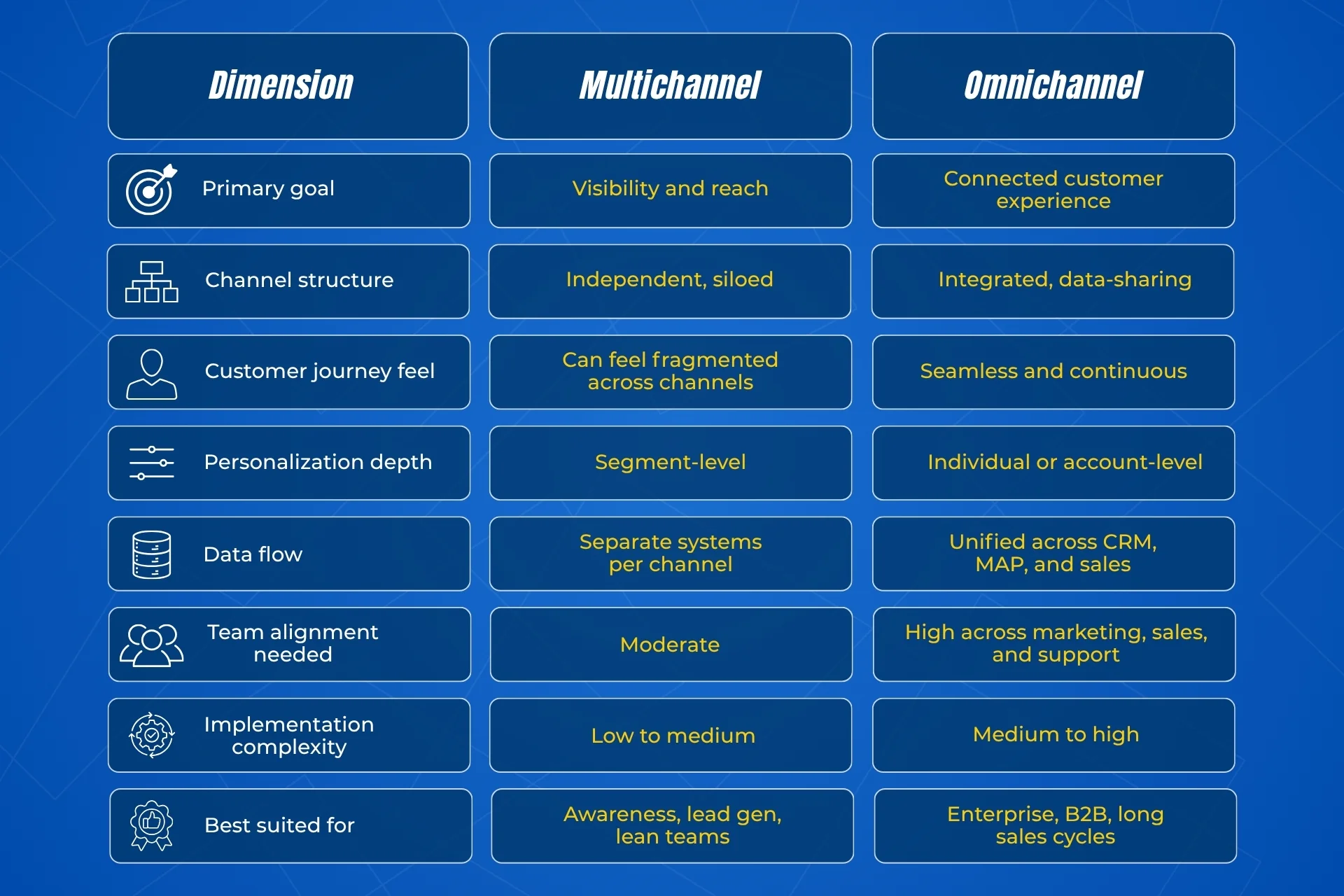
Omnichannel vs Multichannel Marketing: Core Differences
Multichannel marketing is a strategy for customer reach, whereas Omnichannel Marketing is a strategy for customer experience.
Why Businesses Are Moving Toward Omnichannel Marketing
Customer expectations have changed significantly in the last few years. Modern buyers expect businesses they interact with to remember their previous interactions and continue conversations smoothly across various channels.
Research from PwC’s customer experience report has provided a more detailed picture of why this shift has taken shape:
- Customers are willing to pay a premium for superior, seamless experiences
- Poor or inconsistent experiences can significantly lead to customer churn
- Businesses that fail to meet the rising expectations of their customers risk losing ground to competitors who do.
This is one of the biggest reasons businesses are investing more heavily in omnichannel strategies. These findings explain why omnichannel investment has moved on from “nice to have” to being a strategic priority. The business case is straightforward: when customers are made to feel understood and valued at every touchpoint, they will stay longer, spend more, and even advocate for the brand.
The modern marketing teams have adapted to this accordingly. It is no longer enough to drive traffic or maximise reach. More importantly, modern-day marketing will prioritise minimising friction throughout the customer journey from first discovery through engagement and up to post-purchase support. This means:
- Minimising gaps between online and offline experiences
- To ensure customers don’t have to repeat themselves when switching channels
- Delivering consistent messaging and personalisation throughout the sales funnel
- Building systems where customer data flows seamlessly and is automatically updated across all channels
By implementing these changes, businesses aren’t just enhancing the customer experience, but also building a more resilient, conversion-focused marketing engine.
Why Omnichannel Delivers Better Results for B2B Businesses
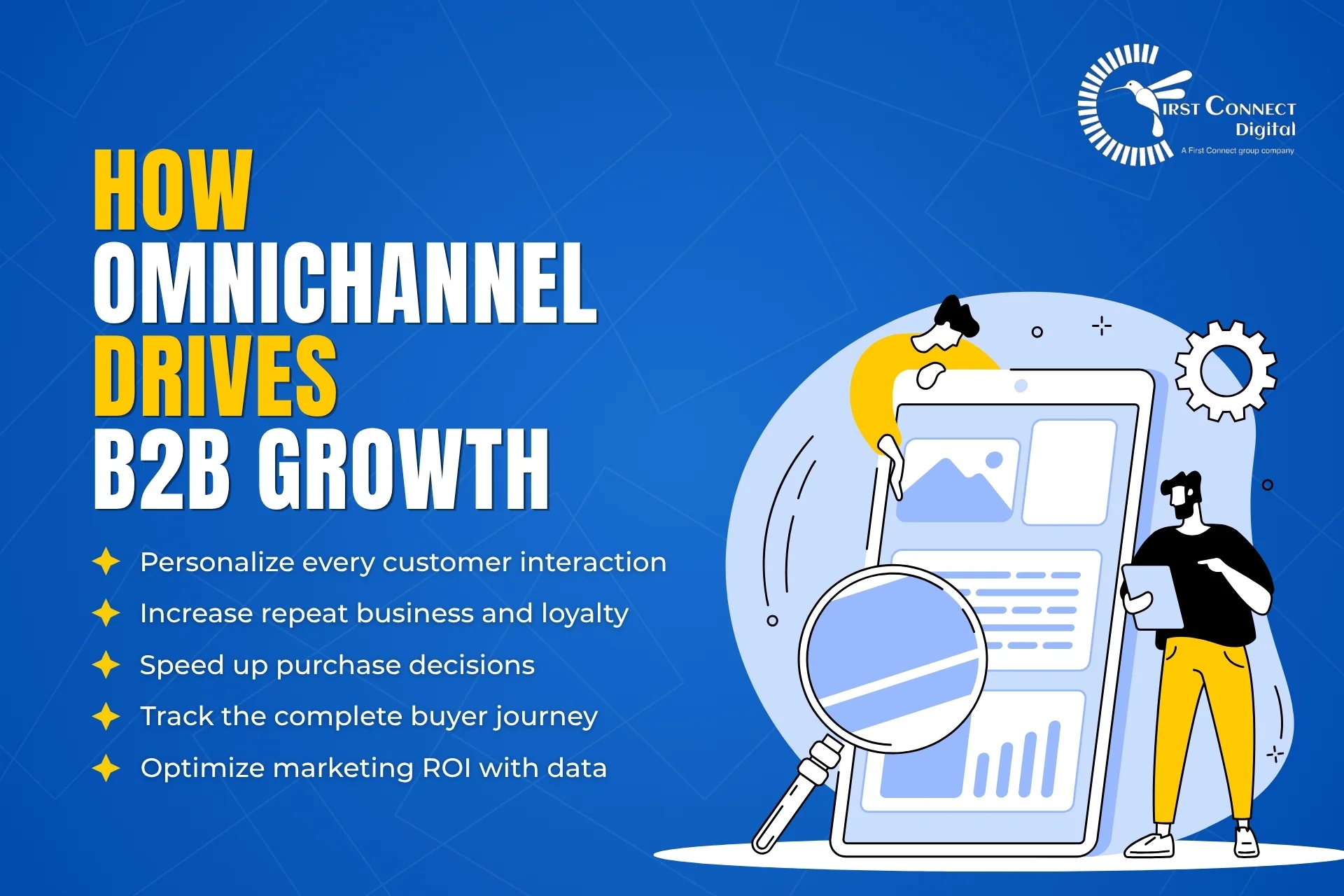
When omnichannel is done effectively, the performance difference is hard to ignore. Here’s the reason why it tends to outperform its competitors across the metrics based on definable measurements:
1. Personalisation that actually lands
Because you can track customers’ data across your systems, it’s no longer guesswork when trying to figure out what your customers want; you can see what they’ve engaged with or not and what stage they’re at. Messaging that reflects real context converts at much higher rates than generic sequences. Targeting your customer with messages that directly reflect the reality of their engagement will ultimately lead to an increase in conversions when compared to generic messaging. McKinsey found that businesses that are leaders in the area of personalisation generate 40% more revenue from their marketing than average competitors.
2. Turning One-Time Buyers Into Repeat Customers
By delivering consistent and connected experiences, you reduce the friction that makes customers quietly look for alternatives. The research completed by Harvard Business Review shows that customers who receive a quality experience are typically more loyal, and omnichannel is what makes a quality experience to reach customers at scale.
3. Faster conversion cycles
When a buyer doesn’t need to re-introduce themselves every time after they switch channels, the journey shortens. There are no repeated questions, no mismatched offers, and no restarted conversations. The process of being interested in making a purchase becomes more streamlined.
4. A clearer picture of what’s actually working
A connected system provides a consolidated view of customer behaviour throughout all channels, which allows for better budgeting, priority placement on accounts, and the ability to monitor what actually drives success in the pipeline, as opposed to simply noting the most recent contact before sale.
Does Multichannel Still Work?
If you are asking if multichannel continues to perform, the answer is “yes,” while many people who think of “omnichannel” may assume that multichannel is no longer viable or effective — it’s still a viable option. Multichannel marketing continues to deliver strong results, particularly for businesses focused on expanding reach, building awareness, and generating demand across multiple platforms.
For startup companies, for businesses focused on top-of-funnel awareness, and for teams without the limited resources to build a fully integrated stack, multichannel marketing is a sensible and often highly effective approach. Not every company needs a fully integrated omnichannel ecosystem immediately. Multichannel continues to produce strong results and is an effective solution for companies that need to reach new audiences, create brand awareness, and generate leads across many channels.
Being present on the right platforms, with the right message, at the right frequency, that alone drives real growth. In many cases, businesses first focus on building visibility through multiple channels before investing in deeper integration later. Most companies do not require a comprehensive omnichannel marketing solution at the outset of their business.
The challenge usually begins when customer journeys become more complex, when reps are losing deals because they have no context on what marketing has already sent; when customers lead to inconsistent messages across channels; or when personalisation has stayed generic long after someone gave you enough signal to do better. That’s when the cost of staying multichannel starts to outweigh the cost of integrating.
Real-World Example: Starbucks
Starbucks is a prime example of an omnichannel marketing approach as it uses the mobile app, loyalty program, digital payment system, e-mail campaigns, and in-store experience to create an integrated ecosystem. Customers earn reward points at Starbucks and can redeem their points both online and in-store; therefore, the customer experiences the same personalised offers and can make purchases seamlessly.
Starbucks has demonstrated how the use of an omnichannel model has enhanced customer loyalty and repeat business. The takeaway from this for B2B is that the communication channels are not the product; it is about how well they work together and create an integrated customer experience.
Why Omnichannel Matters More in B2B Businesses
For the B2B businesses, the difference becomes even more relevant since the buying journeys are longer, and multiple touchpoints are common. A B2B buying process is hardly ever concluded in a single interaction; a buyer may choose to read a blog, attend a webinar, download white papers, talk with the sales teams, and consume LinkedIn’s content before making a decision.
Disconnected systems create friction throughout this process. Omnichannel marketing allows B2B companies to create more personalised and consistent journeys for the entire sales cycle.
According to McKinsey’s B2B Pulse research, B2B buyers now prefer a balanced mix of digital self-service, remote interactions, and in-person communication throughout the buying journey. Businesses that connect these touchpoints effectively often create better customer experiences and stronger conversion rates.
The Real Challenges of Going Omnichannel
It would be dishonest to make omnichannel sound like a simple upgrade. It does take time, investments, effort, and planning to build an omnichannel ecosystem. Most businesses do not switch to omnichannel marketing overnight. The reason most businesses haven’t fully made the transition isn’t a lack of awareness; it’s that building the infrastructure is genuinely difficult.
1. Data silos are deep-rooted
The number of tools involved with running a business has also increased over the years, each with its own data model. Getting CRM, MAP, website analytics, and ad platforms to share data cleanly requires real integration work and usually surfaces data quality problems that have been quietly growing for years. As a result, connecting those systems has become significantly more challenging than in the past. In addition, many companies’ databases are fragmented and disconnected, causing more complexity and expense than necessary.
2. Team alignment is harder than technology
Connecting the platforms is only half the challenge. Marketing, sales, customer success, and operations teams often have different goals, different tools, and different definitions of what a “good lead” actually means. Without that alignment, a connected system still produces disconnected experiences. Many businesses still rely on different processes to track sales, use stale data, operate on different systems of measure, and lack the capability for effective collaboration with their vendor partners.
3. It needs ongoing maintenance, not just setup
Your customers’ behaviour changes constantly, as do the channels they use to connect to your business. The way in which customers interact with your business now is much more integrated with many available technologies compared to a few years back may not capture how your buyers research today. Omnichannel isn’t a project; it’s a discipline of keeping systems, signals, and messaging aligned with where buyers actually are, continuously.
4. Attribution gets complicated fast
When ten channels are connected and all contributing to a conversion, figuring out what deserves credit is a genuinely hard analytical problem. Many companies believe they get a great amount of additional revenue from their use of multiple channels; however, once the attribution model has been built for the company, they struggle to prove ROI because the attribution model wasn’t designed for it.
How Businesses Can Transition Toward Omnichannel Marketing
Organisations typically move toward omnichannel marketing by addressing specific gaps in the customer journey. This may involve connecting CRM data with marketing platforms, improving cross-channel visibility, or introducing personalised communication based on customer behaviour.
1. Centralise your customer data first
Before changing any campaigns, connect your core systems. Get your CRM, marketing automation, and website analytics talking to each other. Even without any orchestration logic yet, this surfaces insights that immediately change how you prioritise accounts and allocate budget.
2. Align on definitions before adding tools
What counts as a qualified lead? What signals should trigger a sales follow-up? Document these decisions with both sales and marketing before you automate anything. Automation speeds up good decisions, but it also speeds up bad ones.
3. Pick one segment and orchestrate it fully
Instead of implementing an omnichannel strategy across your entire market, begin with your highest-value segment. Start with the accounts that generate the largest deals or the industry where your win rate is strongest. Build a connected customer journey for that segment first, measure the impact, and then expand the approach across other audiences and markets.
4. Make messaging consistent before making it personal
Before worrying about personalisation, make sure the baseline story is the same across channels. A prospect shouldn’t get a different value proposition from your paid ads than they do from your sales deck. Consistency is the foundation that personalisation builds on top of.
5. Measure incrementally
Run connected campaigns alongside your existing approach on a segment you can isolate. The clearest proof of omnichannel ROI comes from controlled comparisons, not just aggregate improvements that could have multiple causes.
A properly integrated omnichannel foundation connected CRM, MAP, and ABM platform with shared data and aligned workflows typically takes three to six months to build and another quarter to perform. Plan accordingly, and don’t measure against a multichannel baseline before the foundation is stable.
Which Strategy Should You Choose?
Choosing between multichannel and omnichannel marketing depends on your business goals, customer journey, and operational maturity. Multichannel marketing helps brands establish a presence across multiple touchpoints, while omnichannel marketing ensures those touchpoints work together to create a seamless customer experience.
For organisations with longer buying cycles and multiple customer interactions, investing in a more connected approach often delivers stronger results. The goal is not to be present on every channel, but to ensure that each interaction contributes to a consistent and relevant customer journey.
Key Takeaways
- The difference between omnichannel and multichannel marketing lies in the customer experience, not the number of channels being used.
- Multichannel marketing remains effective for reach and awareness, but disconnected channels can create friction as customer journeys become more complex.
- Omnichannel marketing connects data, communication, and customer interactions to deliver more personalised and consistent experiences.
- For B2B companies, a connected approach becomes increasingly important as buyers move across multiple touchpoints before making a decision.
- The most successful omnichannel strategies focus on reducing customer journey friction rather than simply adding more channels.
Frequently Asked Questions (FAQs)
Omnichannel vs Multichannel Marketing
1. What is the main difference between omnichannel and multichannel marketing?
Multichannel marketing uses multiple independent platforms, while omnichannel marketing connects those platforms into one seamless customer experience.
2. Is omnichannel marketing more expensive?
Yes. Omnichannel marketing often requires advanced CRM systems, integrations, automation tools, and centralised customer data management.
3. Which strategy is better for customer retention?
Omnichannel marketing generally performs better because customers receive more personalised and consistent experiences.
4. Can small businesses use omnichannel marketing?
Yes. Small businesses can start by connecting basic systems like CRM, email marketing, and customer support tools before scaling further.
5. Is multichannel marketing outdated?
No. Many businesses still use multichannel marketing successfully, especially during early growth stages or when budgets are limited.