 logo
logo



B2B marketers are still spending their budget on people who are not going to buy from them. The reason is not an undefined target audience but unclear insights into the buying intent of the audience.
As of 2025, companies using intent-driven targeting are reporting 2–4x ROI compared to traditional targeting approaches, with 25–35% higher conversion rates and 30–40% shorter sales cycles. But the shift from traditional to intent-based marketing is not simply a tool upgrade. It requires a different understanding of when and why buyers are reachable, and what drives a decision to act.
This article breaks down how traditional targeting works, where it fails, what intent data and intent data marketing actually do differently, and which approach produces measurable returns for B2B teams operating in 2026.
Drawbacks of Traditional Targeting
The root of all drawbacks in traditional marketing is its very premise.
The common workflow is as follows:
- Identify companies that match your ideal customer profile and push messaging toward them.
The inputs are largely static, mostly including company size, industry vertical, job title, and geography, which define the audience. From here, the B2B teams plan the outreach strategy comprising:
- Paid ads
- Email sequences
- Cold calls
- Trade event sponsorships
What is the core issue with traditional B2B targeting strategies?
The demographic data acquired through this channel describes who a buyer is, not whether they are ready to buy.
A simple example will help us understand this better:
A CFO at a 500-person SaaS company may perfectly match your ICP. That same CFO, however, may have just renewed a three-year contract with your competitor two months ago. Traditional targeting has no way to distinguish between the two.
This results in several compounding inefficiencies:
- Wasted ad spend on accounts with no active buying interest
- High cost-per-lead from outreach that generates form fills but not pipeline
- Long sales cycles because reps enter the conversation after the shortlist has already been formed
- Low personalization due to limited behavioral context at the point of outreach
Gartner research confirms that B2B buyers spend only 17% of their total purchase journey actually talking to suppliers.
The remaining 83% happens independently — through research, peer communities, review sites, and content consumption. Traditional targeting, by definition, cannot access that 83%. It only becomes visible when the buyer raises their hand. By then, the decision is often close to being made.
Intent data has emerged as a major solution to this.
The benefits of intent data marketing to the B2B outreach strategy have been discussed at length in the sections below.
What is Intent Data?
Intent data is behavioral intelligence acquired via first-party and third-party sources and platforms. It identifies which companies are actively researching topics, solutions, or competitors based on their digital activity across the web.
According to Bombora’s intent data definition, it is buyers’ online activity data, procured ethically, indicating when buyers are actively researching online for a solution, and which products and services they are interested in, based on the web content they consume.
These insights are used by marketing and sales professionals to target the prospects who are ready to invest.
For business-to-business (B2B) companies, this insight can help boost sales, shorten the sales cycle and reduce the cost of customer acquisition.
Types of Intent Data
Though Mailchimp divides intent data into four categories, the most common categorization has been depicted in the table below:
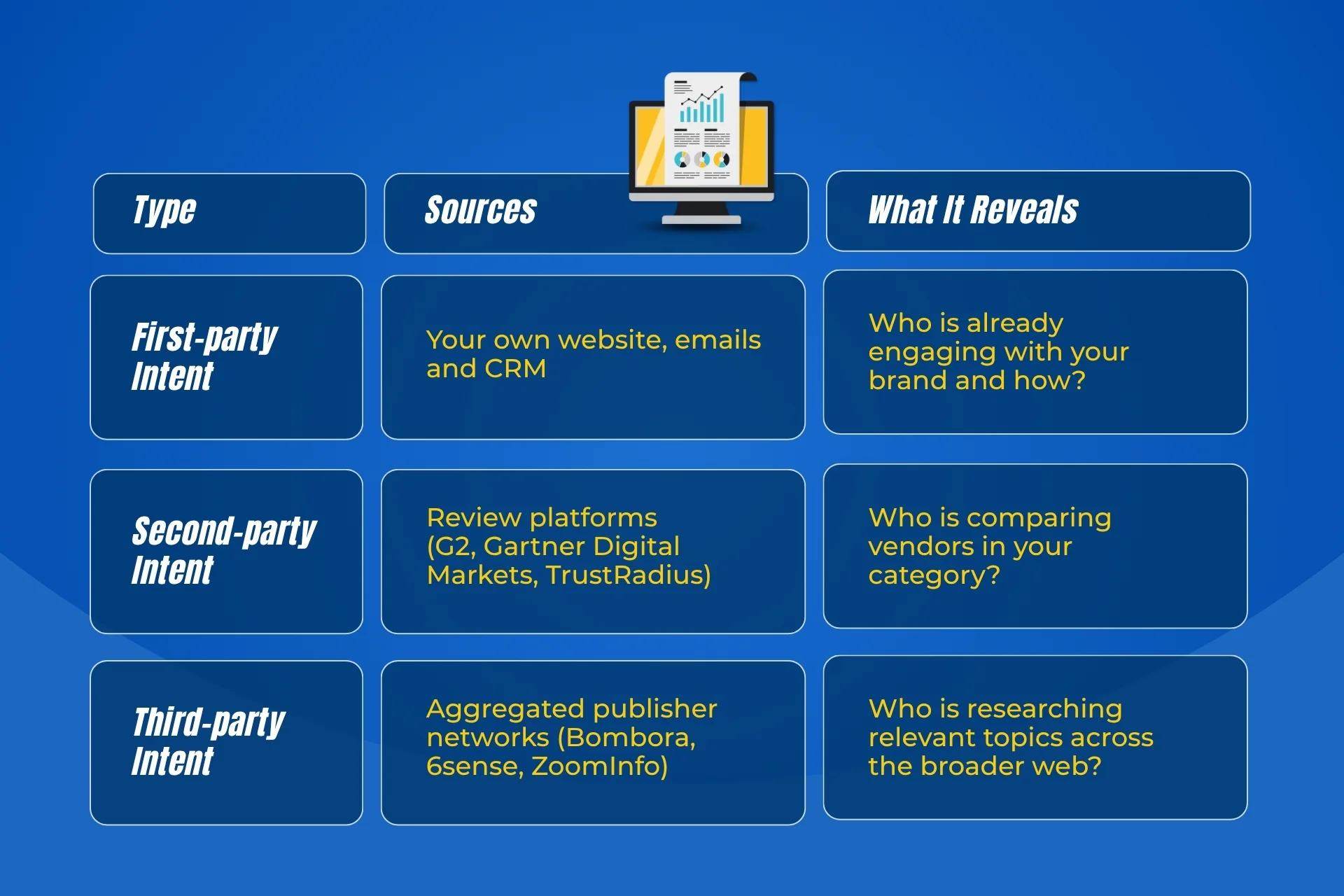 The combination of these three layers creates a complete picture of where an account sits in its buying journey — unlike traditional outreach methods, where accounts are selected based on assumed demographics rather than actual behavior.
According to Gartner, organizations using intent data are twice as likely to achieve a 10% or higher top-of-funnel conversion rate compared to the industry average of 6%. That compounding effect carries through every stage of the funnel.
Forrester’s research adds that companies using intent data in their data-driven marketing see up to a 40% increase in lead conversion rates, but only when intent is integrated into a comprehensive, long-term activation plan rather than used as a one-off signal layer.
The ROI Comparison: Intent Data Marketing vs Traditional Targeting
The most meaningful way to evaluate these two approaches is by examining how each performs against the metrics that matter to B2B revenue teams.
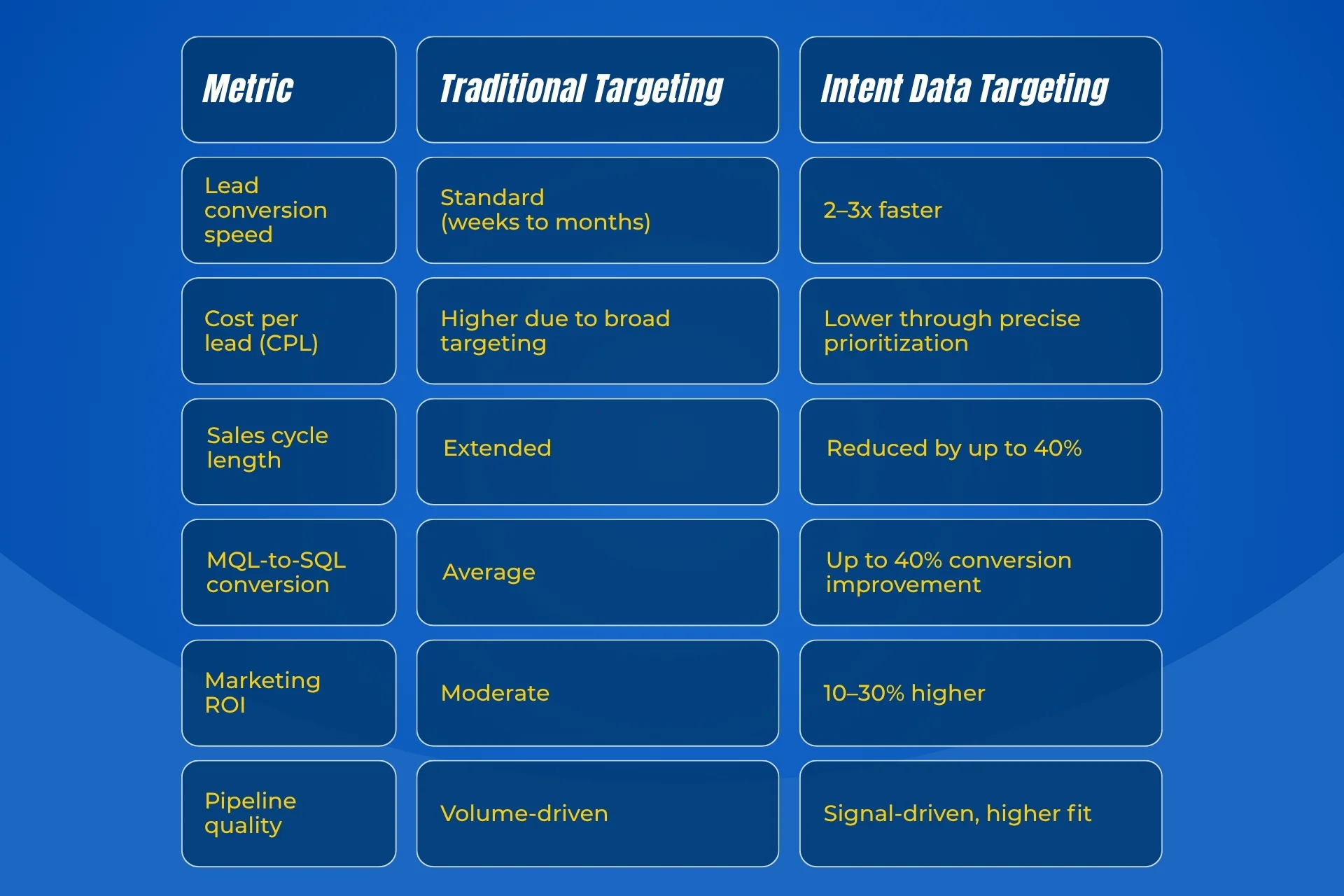
Learnings for B2B marketers:
While more leads may appear to be the right approach, intent data changes the strategy to more qualified leads. These leads are better-timed, which means reaching out to accounts when they are about to make a decision.
How Intent Data Marketing Reshapes Lead Generation
Here is a real-world example of intent data at play.
Consider a B2B SaaS company selling revenue intelligence software. Under a traditional model, the SDR team works a target account list built on firmographics — companies with 200–1,000 employees in the financial services sector. Every account on the list receives the same outreach cadence regardless of current buying activity.
Now layer in buyer intent data.
The platform flags that three accounts on that list have dramatically increased their consumption of content around “revenue forecasting accuracy” and “pipeline visibility tools” over the past two weeks. One of those accounts has had employees visiting two competitor pricing pages on G2. Another has downloaded a comparison guide from a B2B media publisher.
These accounts are not more qualified demographically than the rest of the list. But they are more qualified behaviorally. They are in-market now.
The SDR who reaches out to these three accounts this week — with messaging that speaks directly to pipeline visibility and forecasting accuracy — is entering a conversation the buyer is already having. The SDR working the full list with generic outreach is not.
That difference in timing and relevance is where intent data’s ROI advantage is generated. It is also precisely why Gartner predicts that by 2028, 90% of B2B buying will be AI-agent intermediated, pushing over $15 trillion of B2B spend through AI-driven exchanges — making behavioral signal capture not a competitive advantage, but a baseline requirement.
The Limitations of Intent Data: What B2B Teams Need to Know
Intent data is not a complete solution applied in isolation. Several constraints apply in practice.
Signal noise is real – Not every topic surge indicates genuine purchase intent. A company researching a topic may be conducting competitive analysis, publishing content, or onboarding a new team member — not evaluating vendors. Intent signals require validation through additional context, including fit data and first-party behavioral layering.
Data freshness matters – The window between active research and vendor selection in mid-market deals can be as short as two to four weeks. Intent signals from three weeks ago may already reflect a research phase that has concluded.
Activation determines ROI – Having access to intent data and extracting ROI from it are two separate challenges. The Intentsify and Ascend2 State of Intent Data 2024 report found that 57% of marketers reporting exceptional ROI were using campaign execution providers — meaning data was activated through targeted programs, not simply imported into a CRM and left unused. The same report found that 84% of marketers have increased their intent data budgets, reflecting growing confidence in the approach when properly deployed.
Takeaway for B2B Teams – Intent data works when it is embedded into an activation workflow, not when it sits as a standalone data feed. The ROI gap between intent data users and non-users is largely a gap in activation quality, not data access.
Vital Metrics in Intent Data ROI
- Intent-signal-to-opportunity time — how quickly a surging account converts to a sales opportunity
- Pipeline coverage from intent-sourced accounts — what percentage of the pipeline originated from accounts showing prior intent signals
- Conversion rate: intent-scored leads vs. non-scored leads — the clearest head-to-head comparison
- Average deal size by source — intent-sourced deals often carry a higher average contract value due to a better fit and lower friction
- Sales cycle length by lead source — intent-driven leads consistently progress faster through the pipeline
Key Takeaways
- Traditional targeting describes who buyers are. Intent data reveals when they are ready – The ROI gap between the two approaches is fundamentally a timing gap — reaching the right account at the right moment generates compounding returns across every funnel stage.
- The B2B buyer’s journey is largely invisible to traditional targeting- Gartner confirms that buyers spend only 17% of their purchase journey with suppliers. Intent data provides visibility into the 83% that happens independently.
- Intent data’s advantage compounds across the funnel – Earlier, more relevant awareness engagement produces stronger consideration-stage performance, which reduces conversion-stage friction — creating a cumulative ROI that volume-based targeting cannot replicate.
- Activation quality determines ROI, not data access alone – The organizations extracting the most from intent data are those that have embedded signal outputs directly into CRM workflows, sales sequences, and campaign execution — not those treating intent as a reporting layer. The Forrester Wave: Intent Data Providers for B2B, Q1 2025 provides a current reference for evaluating platform options.
- The measurement framework must change – Evaluating intent data against traditional volume metrics will understate its impact. Pipeline velocity, intent-signal-to-opportunity time, and conversion rate by lead source are the metrics that make the ROI of intent-driven programs visible.
FAQs
Intent Data Marketing vs Traditional Targeting
1. How is intent data different from behavioral retargeting?
Retargeting targets users who have already visited your website — a first-party signal. Intent data, particularly third-party intent from providers like Bombora or 6sense, identifies accounts showing buying signals across the broader web before they arrive at your site.
It allows outreach earlier in the research cycle, not just after a prospect has already found you.
2. Is intent data suitable for mid-market B2B teams, or is it primarily an enterprise tool?
Intent data platforms are now available across all market segments. Enterprise platforms like 6sense and Demandbase are built for large account-based marketing programs.
Mid-market and SMB teams can access intent signals through platforms like ZoomInfo, HubSpot, and Bombora integrations within their existing CRM. The right entry point depends on pipeline volume and which funnel stage has the highest conversion loss.
3. How long does it take to see measurable ROI from intent data?
Most intent data programs require four to eight weeks of calibration before signal recommendations reach reliable accuracy. Teams tracking the right metrics — pipeline coverage from intent-sourced accounts, intent-signal-to-opportunity time — typically see measurable ROI within the first quarter of deployment.
The fastest returns come from identifying a single conversion bottleneck and deploying intent signals to solve that specific problem before expanding the program.
4. Can intent data and traditional targeting be used together?
Yes — and for most B2B teams, the most effective approach is to use intent data to sharpen and prioritize traditional targeting, not replace it. Firmographic filters define the addressable market.
Intent signals identify which accounts within that market are active right now. The combination produces better timing, higher relevance, and measurable improvement in pipeline quality without requiring a complete overhaul of existing marketing infrastructure.
As Gartner's emerging technology analysis on intent data notes, the strongest implementations combine precision targeting with existing demand generation infrastructure.